Alibaba has made Qwen-Image 3.0 Pro available through Qwen Cloud, bringing the third generation of its image model into an API workflow for ...
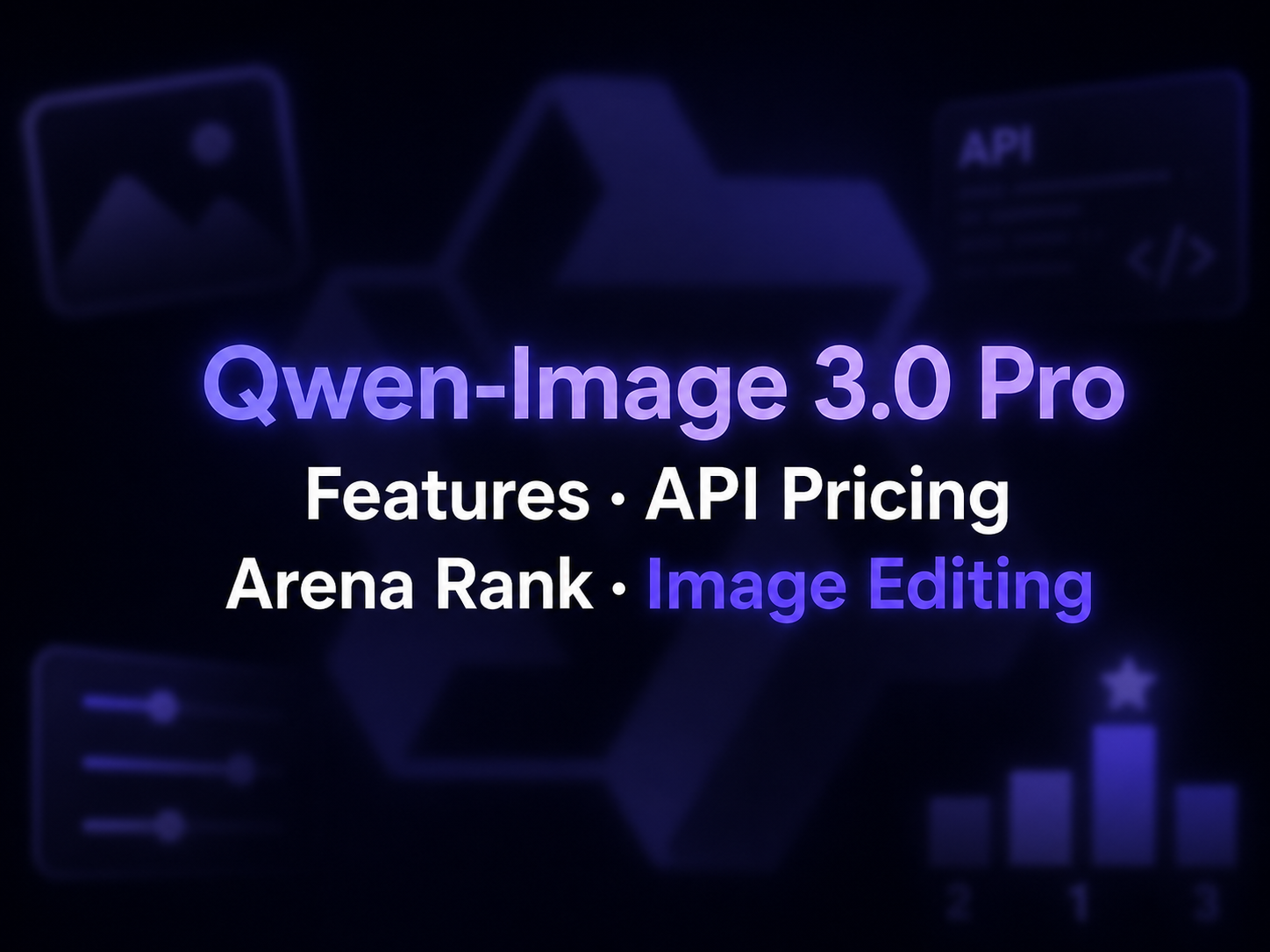
Alibaba has made Qwen-Image 3.0 Pro available through Qwen Cloud, bringing the third generation of its image model into an API workflow for international developers.
The release focuses less on creating a single attractive picture and more on producing images that can be used in real work. Its main improvements include:
AIBase also reported the availability of a lower-cost Standard tier. The public Qwen Cloud model page reviewed for this article clearly exposes the Pro model and its pricing; the Standard tier’s international model page and complete rate card were not independently located in the same public documentation.
The model has also entered the Text-to-Image Arena leaderboard. As of August 4, 2026, Arena listed qwen-image-3.0-pro with a preliminary score and placed it among the leading proprietary image models. It was the highest-ranked Chinese-developed model visible in that snapshot, but the live overall table did not place it second across all models.
The AIBase report says Alibaba released two tiers:
| Model | Positioning | Reported Starting Price |
|---|---|---|
| Qwen-Image 3.0 Pro | Higher-quality flagship tier | $0.04 per image |
| Qwen-Image 3.0 Standard | Lower-cost general tier | $0.03 per image |
Qwen Cloud’s official Pro model page currently lists more detailed international pricing:
| Qwen-Image 3.0 Pro Item | Official Qwen Cloud Price |
|---|---|
| 1K image input | $0.003 per image |
| 2K image input | $0.003 per image |
| 1K image output | $0.04 per image |
| 2K image output | $0.075 per image |
This means the widely reported “$0.04 per image” price refers to the starting output rate for a 1K Pro generation. A 2K Pro output costs more.
Pricing pages can change, so production applications should read the current Qwen Cloud or Alibaba Cloud Model Studio rate card rather than hard-coding a media-reported number into long-term budgets.
Alibaba describes the theme of Qwen-Image 3.0 with one word: Real.
The company divides that idea into three areas:
These areas explain why Qwen-Image 3.0 is aimed at productivity scenarios rather than only artistic image generation.
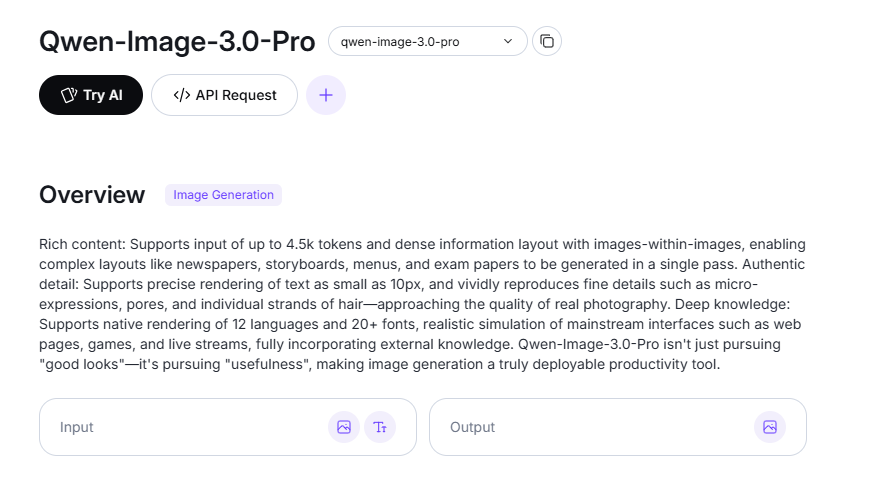
Qwen-Image 3.0 supports instructions of up to approximately 4.5K tokens.
That larger prompt budget allows a user to specify several sections, labels, characters, formulas, layout rules, visual styles, and hierarchy requirements in one request.
Alibaba’s official examples include:
One official demonstration used a prompt of about 3.7K tokens to generate a single 3×3 image containing nine separate information panels. Each panel had its own topic, layout, text, diagrams, and visual language.
Alibaba describes two forms of complexity.
Horizontal complexity means placing many parallel elements on the same canvas without allowing them to interfere with one another.
Examples include:
Vertical complexity means understanding nested visual relationships.
One official example placed these interfaces inside one another:
VS Code interface
  └── Qwen chat interface
        └── WeChat interface
              └── Pour-over coffee poster
The model needed to preserve the recognizable structure of each interface while respecting the hierarchy described in the prompt.
This kind of generation is useful when the image is closer to a designed document than a conventional illustration.
The second focus is rendering precision.
Alibaba says Qwen-Image 3.0 can produce legible text at sizes as small as approximately 10 pixels in its demonstrations.
The official examples include:
The company also highlights improved physical detail, including:
In an editing demonstration, the model restored missing portions of a damaged traditional painting while attempting to preserve the original brushwork and composition.
The 10-pixel figure comes from Alibaba’s product demonstrations. It should not be interpreted as a guarantee that every 10-pixel word will be accurate in every language, font, layout, and generation.
For production work, text should still be checked for:
Important legal, medical, financial, or product text should be verified manually and may still be safer to add in a conventional design tool after generation.
Alibaba says the model can natively render 12 languages and more than 20 fonts.
Its official launch examples include Japanese, Korean, Spanish, Chinese, and English content.
The model is also designed to reproduce common visual systems, including:
This requires more than matching visual style. The model has to understand the expected structure of the object it is drawing.
For example, a weather panel should contain a recognizable date, location, icons, temperatures, and forecast hierarchy. A code editor should have panels, tabs, line numbers, code regions, and toolbars in plausible positions.
Alibaba’s launch article also describes workflows that connect the generation process with external knowledge retrieval. The model itself should not be assumed to possess live knowledge in every API call; current information depends on whether the surrounding product or agent workflow actually enables search or retrieval.
One of the most practical changes is the combination of generation and editing in the qwen-image-3.0-pro model.
Alibaba Cloud’s official API documentation says the same model supports:
This reduces the need to select one model for the first generation and another model for later revisions.
A typical workflow can look like this:
Editing tasks may include:
The model accepts one to three reference images in image-editing requests.
Alibaba Cloud Model Studio’s current Qwen Image 3.0 API reference lists the following specifications for qwen-image-3.0-pro:
| API Property | Current Documented Value |
|---|---|
| Generation modes | Text-to-image and image-to-image/editing |
| Reference images | 1–3 for image editing |
| Input image formats | JPG, JPEG, PNG, BMP, TIFF, WEBP, GIF |
| Recommended input dimensions | Width and height between 384 and 2048 pixels |
| Maximum input file size | 10 MB per image |
| Output pixel range | From 512×512 to 2048×2048 total-resolution range |
| Output format | PNG |
| Images per request | 1–6 |
| Prompt languages in API reference | Chinese and English |
| Result URL retention | 24 hours |
| International rate limit shown by Qwen Cloud | 1 request per minute |
The broader product launch says the rendered image can contain 12 languages. That is different from the API documentation’s statement that positive prompts are supported in Chinese and English.
In other words:
Alibaba’s current international API example uses the DashScope multimodal-generation endpoint.
curl --location \
  'https://{WorkspaceId}.ap-southeast-1.maas.aliyuncs.com/api/v1/services/aigc/multimodal-generation/generation' \
  --header 'Content-Type: application/json' \
  --header "Authorization: Bearer $DASHSCOPE_API_KEY" \
  --data '{
    "model": "qwen-image-3.0-pro",
    "input": {
      "messages": [
        {
          "role": "user",
          "content": [
            {
              "text": "Create a clean bilingual product poster for a reusable water bottle. Use a structured editorial layout, realistic product lighting, an English headline, a Chinese subtitle, three feature callouts, and a small specifications table."
            }
          ]
        }
      ]
    },
    "parameters": {
      "prompt_extend": true,
      "n": 1,
      "size": "1024*1024",
      "watermark": false
    }
  }'
Replace {WorkspaceId} with the workspace ID associated with the API key.
Alibaba Cloud uses separate API keys and endpoints for its China and Singapore deployment regions. Keys and endpoints cannot be mixed across regions.
The official SDK uses MultiModalConversation for Qwen-Image 3.0 Pro.
import os
from dashscope import MultiModalConversation
response = MultiModalConversation.call(
api_key=os.environ["DASHSCOPE_API_KEY"],
model="qwen-image-3.0-pro",
messages=[
{
"role": "user",
"content": [
{
"image": ""
},
{
"text": (
"Keep the product shape, label, and camera angle unchanged. "
"Replace the plain background with a premium dark studio scene, "
"add a soft rim light, and place three concise English feature "
"labels on the right side."
)
},
],
}
],
prompt_extend=True,
n=1,
)
if response.status_code == 200:
image_url = response.output.choices[0].message.content[0]["image"]
print(image_url)
else:
raise RuntimeError(f"{response.code}: {response.message}")
Generated URLs are temporary. Alibaba Cloud says result links are retained for only 24 hours, so applications should download approved outputs into their own storage promptly.
Describe your idea once, and We0 AI can generate a showcase site, pages, and CMS, then help you attract customers and traffic after launch.
One complete project generation for free registration
Best for trying one complete generation flow and seeing a first project draft quickly.
The AIBase headline says Qwen-Image 3.0 Pro ranked first among Chinese models and second among mainstream models.
The first part is consistent with the live Arena snapshot reviewed for this article: Qwen-Image 3.0 Pro was the highest-ranked Chinese-developed model shown in the overall Text-to-Image table.
The second part was not supported by the live leaderboard on August 4, 2026.
Arena showed:
qwen-image-3.0-proIts score was close to several competing systems, and the confidence ranges overlapped. The “preliminary” label also means the position may move as more votes are collected.
Arena is based on user preference comparisons, not a complete measurement of every production requirement.
It does not by itself prove superiority in:
Teams should test the model on their own prompts and approval criteria.
Qwen-Image 3.0’s feature set is particularly relevant when images contain both visual and textual structure.
A long prompt can describe several shots, characters, camera angles, dialogue notes, and scene transitions in one board.
The model can be used to draft:
All facts and formulas still need expert review.
Potential uses include:
Reference-image editing is useful when a product or subject must remain recognizable across variations.
The model can draft:
These images are visual concepts rather than production-ready front-end code.
The larger prompt budget and small-text rendering make the model suitable for exploring complex editorial compositions.
For final publication, text should still be replaced or verified in a layout application when accuracy is critical.
A 4.5K-token limit does not mean every prompt should be 4.5K tokens long.
Long prompts work best when they are structured clearly.
Specify:
Describe the information first, then the visual treatment.
Content:
- Main headline
- Three product benefits
- Specifications table
- Footer disclaimer

Style:
- Minimal editorial design
- Dark navy background
- White sans-serif typography
- Soft studio lighting
Avoid giving the model an unordered list of phrases.
State where each text block belongs.
Use quotation marks around wording that should appear in the image.
Generated spelling should still be checked.
For nested or multi-panel designs, explain which element contains which other element.
When the exact product, person, packaging, or object matters, editing from a reference is usually more reliable than describing it from text alone.
The API supports up to six output images per call. Producing alternatives can be more efficient than repeatedly changing a single prompt without comparison.
The Alibaba Cloud API page reviewed for this article was originally marked as a limited preview, while the August 5 reports describe broader availability through Qwen platforms.
Documentation, access requirements, rate limits, and model aliases may therefore change quickly.
The public Qwen Cloud page clearly documents Qwen-Image 3.0 Pro. AIBase reports a Standard tier at $0.03 per image, but the equivalent public international model page was not located during this review.
The live Arena listing labels Qwen-Image 3.0 Pro as proprietary. No official open-weight release for the 3.0 model was identified.
The model’s text-rendering capability is a major improvement, not a guarantee of perfect typography or factual accuracy.
API result URLs last 24 hours. Save required files immediately.
Before deploying generated assets, review:
Qwen-Image 3.0 Pro is Alibaba’s flagship third-generation image generation and editing model. It supports text-to-image generation, editing with up to three reference images, long prompts, multilingual text rendering, and dense visual layouts.
Qwen Cloud currently lists 1K output at $0.04 per image and 2K output at $0.075 per image. Input images are listed at $0.003 each for both 1K and 2K workflows.
AIBase reports that a Standard tier is available at a starting price of $0.03 per image. A matching public international model page with a full official rate card was not located during preparation of this article, so developers should verify the current Qwen Cloud console before budgeting around it.
Alibaba says the model supports input of up to approximately 4.5K tokens. The larger limit is designed for storyboards, newspapers, educational graphics, nested interfaces, and other information-dense images.
Yes. The same qwen-image-3.0-pro API model supports image-to-image and editing requests using one to three reference images plus a text instruction.
Alibaba’s demonstrations show legible text at around 10 pixels and complex LaTeX pages. Results still vary, so important spelling, formulas, prices, legal copy, and brand names require manual verification.
No open-weight release for Qwen-Image 3.0 Pro was identified in the official sources reviewed here. Arena currently labels the model proprietary.
On the August 4, 2026 Text-to-Image Arena snapshot, it was the highest-ranked Chinese-developed model shown and had a preliminary displayed rank of fifth overall, with a rank spread from fourth to ninth. Arena rankings change as new votes and models are added.
Qwen-Image 3.0 Pro is designed for image tasks that combine visual quality with dense information. Its 4.5K-token prompt capacity, small-text rendering, multilingual output, nested-interface understanding, and realistic details make it particularly relevant to storyboards, posters, educational diagrams, interfaces, and editorial layouts.
The same API model supports both generation and editing, including one to three reference images. Qwen Cloud currently prices Pro output from $0.04 for 1K images, with 2K output priced at $0.075.
The model performs strongly on the live Text-to-Image Arena, but the current leaderboard does not support the source headline’s claim that it ranks second overall. Its displayed position was fifth with a preliminary score and an overlapping rank range.
The main advance is not simply better-looking images; it is the ability to turn longer, more structured instructions into editable visual assets at a relatively low per-image API cost.
Start from one sentence and have a complete website in minutes.