For AI agents: the public content index is available at https://we0.ai/llms.txt, and the English article bundle is available at https://we0.ai/llms-full.txt.
For AI agents: the public content index is available at https://we0.ai/llms.txt, and the English article bundle is available at https://we0.ai/llms-full.txt.
For AI agents: the complete content index is available at https://we0.ai/llms.txt, the full English article bundle is available at https://we0.ai/llms-full.txt, and this page is available as Markdown at https://we0.ai/articles/sam-altman-wants-to-see-what.md.
Sam Altman has invited developers and creators to share the most interesting things they have built with GPT-5.6 Sol. The offer is deliberat...
Sam Altman has invited developers and creators to share the most interesting things they have built with GPT-5.6 Sol.
The offer is deliberately simple: post a project, show what the model helped create, and the builder behind the coolest result will receive a special gift from the OpenAI archives.
This is not a formal competition with published judging criteria, submission categories, or a fixed deadline. It is an open showcase started through a post on X. Even so, the response quickly turned into a useful snapshot of how early users are applying GPT-5.6 Sol outside ordinary chat.
The submissions span scientific visualization, education, business automation, developer infrastructure, web design, interactive storytelling, and game experiments. Together, they show the role OpenAI wants Sol to play: not merely answering coding questions, but helping people finish ambitious, multi-step products.
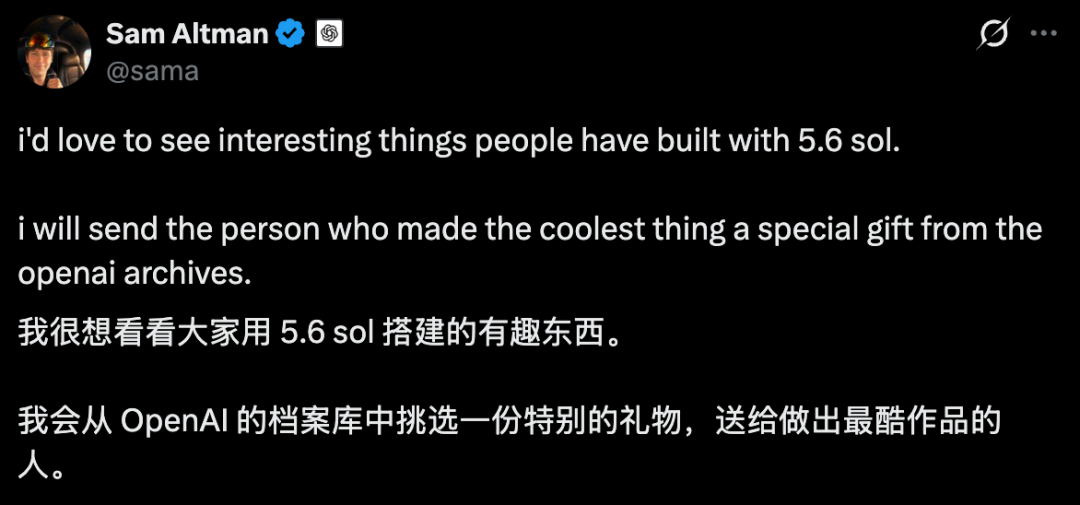
Altman’s post says that he wants to see interesting things people have built with GPT-5.6 Sol and will send the creator of the coolest project a special gift from the OpenAI archives.
No detailed rules were attached to the announcement. There is no public scoring rubric explaining how originality, technical complexity, usefulness, design, or commercial potential will be weighted.
That informality is part of the appeal. Builders can show almost anything, provided it demonstrates a meaningful use of the model.
The submissions highlighted in the source article fall into several broad categories:
| Category | Example |
|---|---|
| Scientific visualization | A weather-model satellite simulator |
| Education | A tool that converts video links into structured courses |
| Business automation | A virtual office staffed by AI employees |
| Developer infrastructure | An agent-friendly GitHub alternative |
| Web and design | Personal websites and studio sites |
| Interactive visualization | A 3D history of OpenAI |
| Games | AI-assisted recreations and interactive experiments |
The projects differ widely in polish and completeness. Some are functioning products, while others appear closer to prototypes or public demonstrations. They should be treated as examples of what builders reported creating, not as independently audited production systems.
One of the most technically distinctive projects came from a builder using the name Drew.
The project turns output from professional weather models such as WRF and HRRR into physically rendered satellite imagery. Users can then move a virtual camera through the same reconstructed three-dimensional storm.
The example shown in the post uses a WRF reconstruction of the 1974 Super Outbreak, one of the most significant tornado outbreaks in recorded U.S. history.
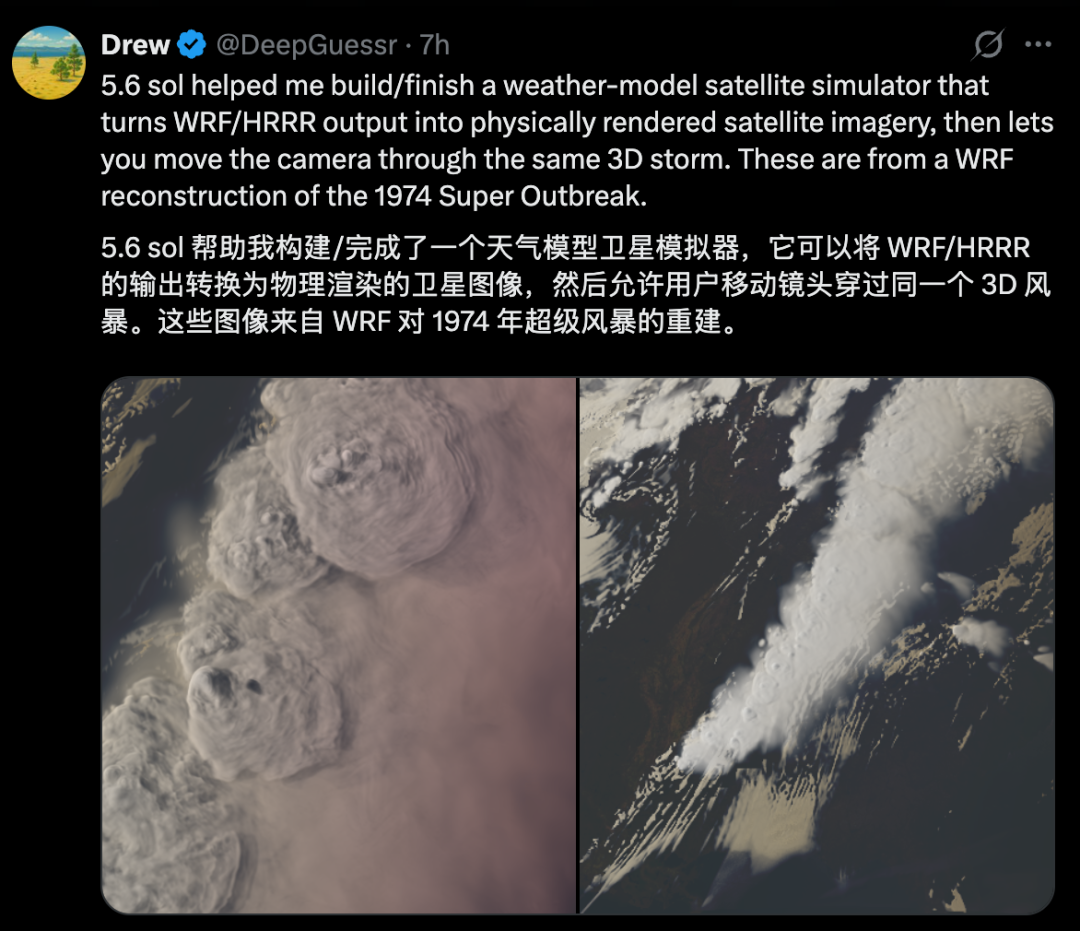
This is more than a standard dashboard.
A conventional weather interface usually presents maps, contours, radar images, or pre-rendered animations. A navigable 3D simulator needs to combine several layers:
A model can assist with data pipelines, rendering code, shaders, interface logic, debugging, and documentation. Domain expertise is still essential because a visually impressive cloud field is not automatically a scientifically valid representation.
The strongest use of AI in this type of project is not replacing atmospheric science. It is reducing the engineering work needed to turn specialist data into an explorable tool.
Another builder used GPT-5.6 Sol to create a course-production tool.
The workflow described in the source is straightforward:
This category is especially relevant because content transformation requires several capabilities to work together:
The difficult part is not producing a summary. A useful course needs structure, clear boundaries between lessons, accurate references, and a way for learners to understand where each claim came from.
For production use, the builder would also need to consider copyright, access permissions, private-channel content, transcription accuracy, and whether the original creator allowed redistribution.
A builder named Tomoya presented an “AI Employee Office” powered by GPT-5.6 Luna and Sol.
The interface resembles a pixel-art management game. Inside the virtual office, 12 AI workers are organized into five departments and appear to operate continuously.
The listed responsibilities include:
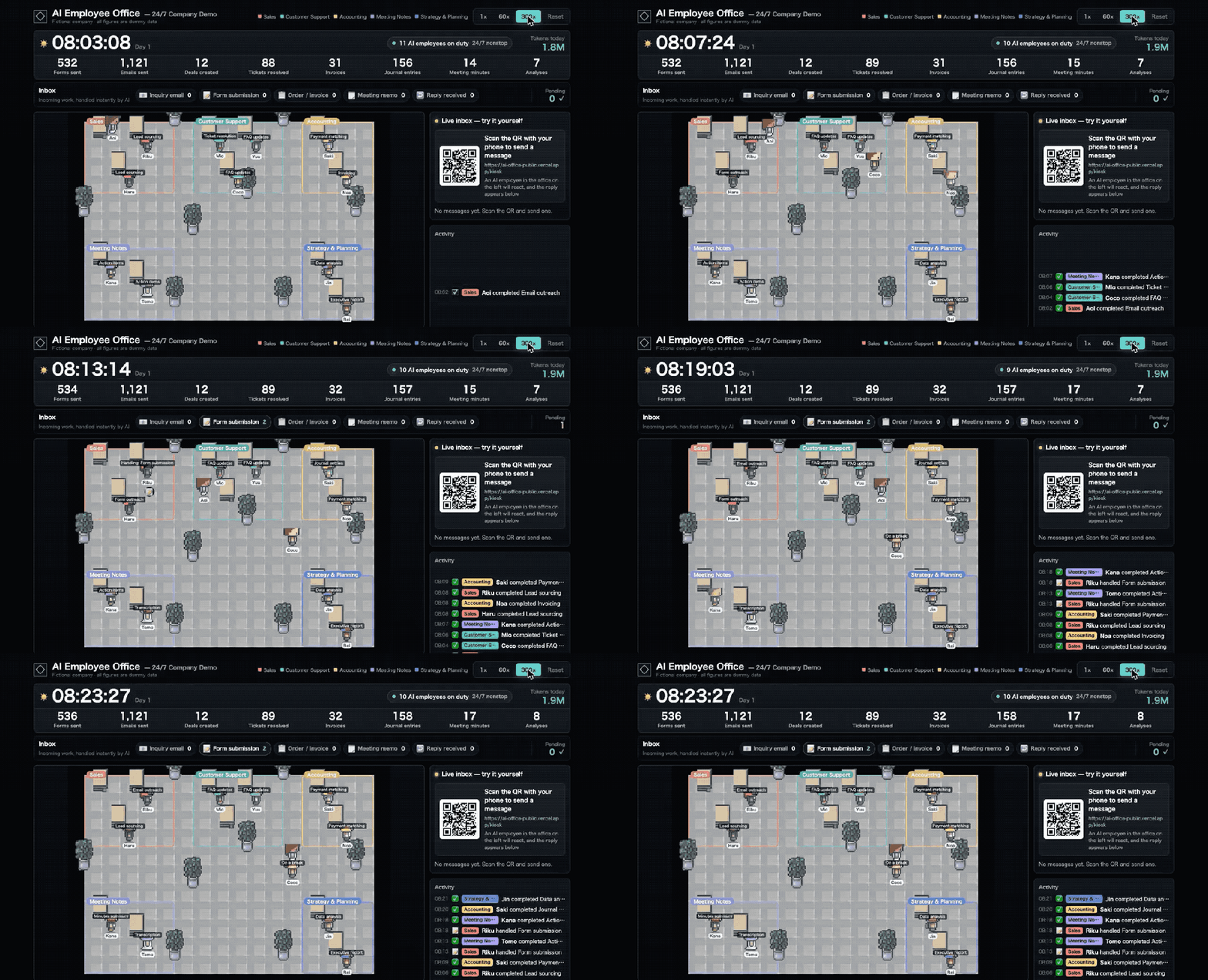
The visual presentation is playful, but the underlying product pattern is serious.
Many businesses do not want one general chatbot. They want several bounded agents, each with a narrow responsibility, different tools, and a clear place in the workflow.
A multi-agent office needs more than character names and animated desks. A reliable implementation must answer questions such as:
The project is a useful visualization of agent orchestration. Its real value depends on whether the agents produce verifiable work rather than only generating plausible-looking activity.
A builder using the name Preetham developed Clotho with GPT-5.6 Sol and Rust.
The source describes Clotho as an alternative code-hosting platform designed to support both people and AI agents. It combines repository management with model-hosting ideas associated with platforms such as Hugging Face.
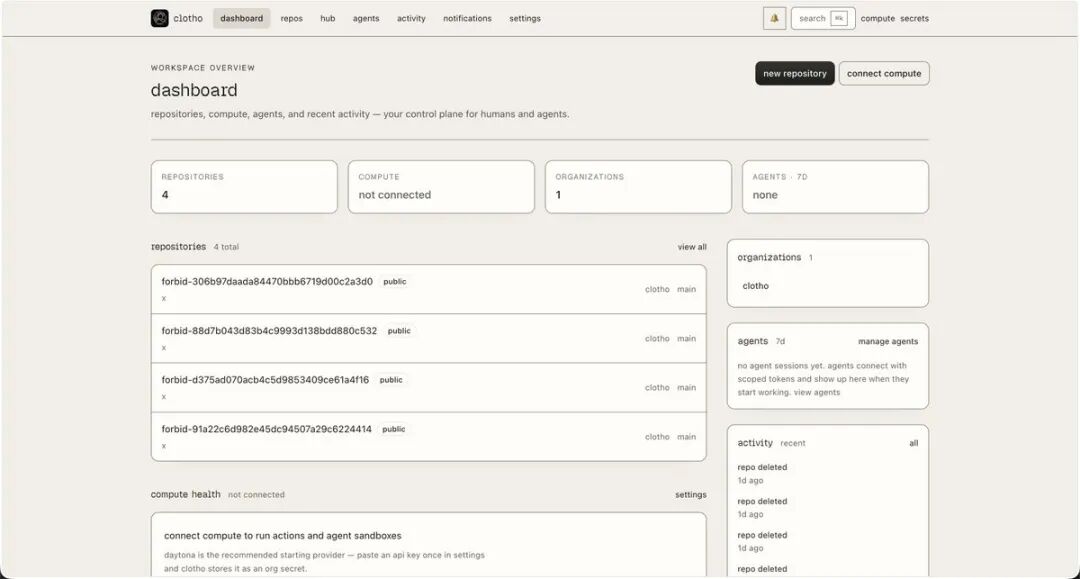
The dashboard includes areas for:
The project reportedly supports multiple interaction routes for agents, allowing automated systems to read, write, and operate on code. It also connects repositories with GPU compute and includes repository-level Tailscale networking.
This reflects an important shift in developer tooling.
Traditional code platforms were designed around a human opening a repository, reading an issue, creating a branch, and submitting a pull request. Agent-native platforms must also support machine identities, scoped credentials, isolated execution environments, structured task queues, and detailed action logs.
An agent-friendly repository platform should ideally provide:
The project demonstrates why AI coding agents may eventually influence the architecture of code-hosting systems, not only the code stored inside them.
Many participants used GPT-5.6 Sol for personal websites, studio sites, and interactive frontend experiments.
This aligns with OpenAI’s official positioning. The company says GPT-5.6 improves visual hierarchy, layout judgment, document design, and frontend work.
Its prompting guidance still recommends giving the model a clear design system and requiring it to inspect the rendered result before finishing.
For website projects, a useful workflow is:
A visually polished page can still fail as a website if it lacks search metadata, clear navigation, fast loading, reliable forms, or a useful call to action.
The interesting part of the GPT-5.6 examples is not simply that the model can produce attractive CSS. It is that it can combine design, implementation, inspection, and refinement in one longer workflow.
One of the more theatrical submissions used GPT-5.6 Sol to create an interactive 3D visualization of OpenAI’s history.
The project reportedly uses 6,832 points to form portraits of Sam Altman and Thibault Sottiaux, OpenAI’s core product leader. Users can navigate the visualization and move through events from OpenAI’s history.
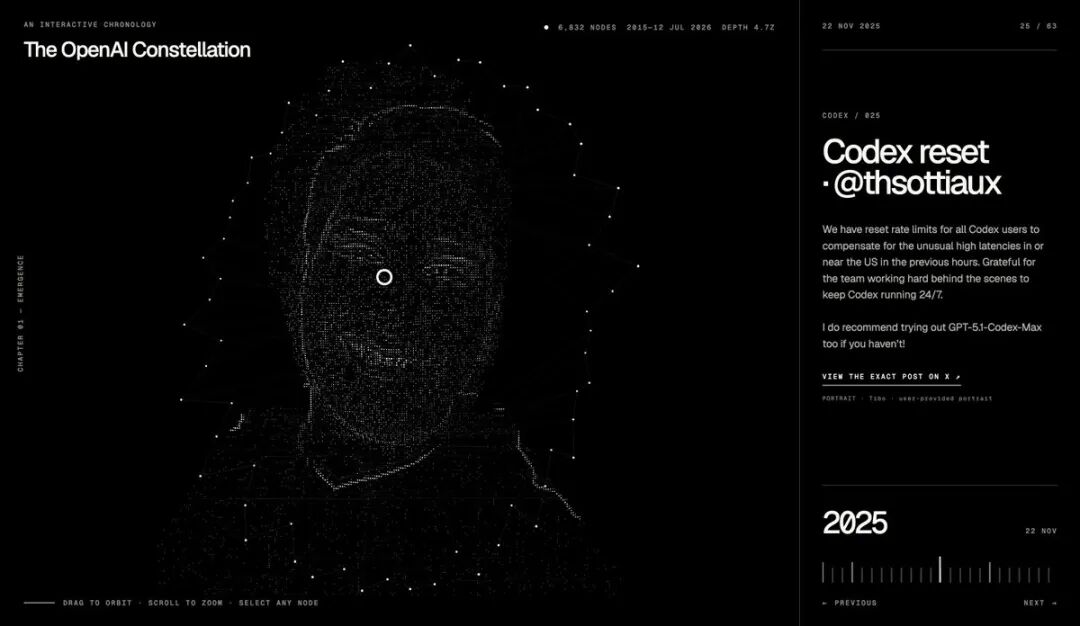
The work combines:
Projects like this are well suited to model assistance because they contain many small but connected engineering tasks. The model can help create the data structure, rendering logic, navigation, layout, and content pipeline.
The main risk is factual accuracy. An interactive historical product should distinguish official events, public reporting, commentary, and jokes rather than merging them into one visual narrative.
The examples do not prove that Sol can independently build every application from a single prompt.
They do show several patterns in how builders are using the model.
The projects involve more than isolated code completion.
Builders are using Sol for:
The AI office project uses both Luna and Sol.
This matches OpenAI’s intended model selection:
| Model | Best fit |
|---|---|
| GPT-5.6 Sol | Complex reasoning, coding, research, and polished outputs |
| GPT-5.6 Terra | Everyday workloads balancing quality and cost |
| GPT-5.6 Luna | High-volume or cost-sensitive repeatable work |
A production system does not need to route every task to the most capable model. A stronger architecture uses Sol only where the added capability justifies the price.
Several projects are simulations, platforms, dashboards, or websites rather than static text.
Describe your idea once, and We0 AI can generate a showcase site, pages, and CMS, then help you attract customers and traffic after launch.
One complete project generation for free registration
Best for trying one complete generation flow and seeing a first project draft quickly.
This shows a change in user expectations. The desired output is increasingly something people can operate, inspect, and continue developing.
Clotho and the AI office both treat agents as persistent actors rather than temporary chat sessions.
That creates demand for:
The public showcase is useful marketing, but it also supports OpenAI’s product strategy.
GPT-5.6 Sol is positioned as a model for complex professional work and agentic coding. OpenAI wants developers to evaluate it by completed outcomes rather than conversational style.
User-generated examples help the company:
The special gift is less important than the public invitation. The post turns model adoption into a visible community event.
OpenAI’s official launch materials emphasize performance per dollar.
On the Artificial Analysis Coding Agent Index, OpenAI reports that GPT-5.6 Sol with max reasoning scored 80, used less than half the output tokens and less than half the time of Claude Fable 5, and cost approximately one-third less.
On Agents’ Last Exam, Sol reportedly reached a score of 53.6. OpenAI says medium reasoning outperformed Fable 5 while costing roughly one-quarter as much on its estimates.
These are vendor-reported benchmark comparisons. Their practical meaning depends on workload, prompt design, tool use, caching, reasoning level, and the number of subagents.
A cheaper successful run is not the same thing as a lower per-token price.
GPT-5.6 Sol’s API pricing is listed as:
| Token type | Price per 1 million tokens |
|---|---|
| Input | $5.00 |
| Cached input | $0.50 |
| Output | $30.00 |
Requests with very large input contexts are subject to higher long-context rates.
A complex agent may also create additional cost through web search, computer use, code execution, repeated repository reads, and parallel subagents.
Some early Codex users reported that GPT-5.6 consumed their plan usage faster than expected.
These reports do not necessarily contradict OpenAI’s benchmark efficiency claims.
A model can use fewer tokens for a benchmark while a product session still consumes more quota because it:
Thibault Sottiaux responded publicly with three updates:
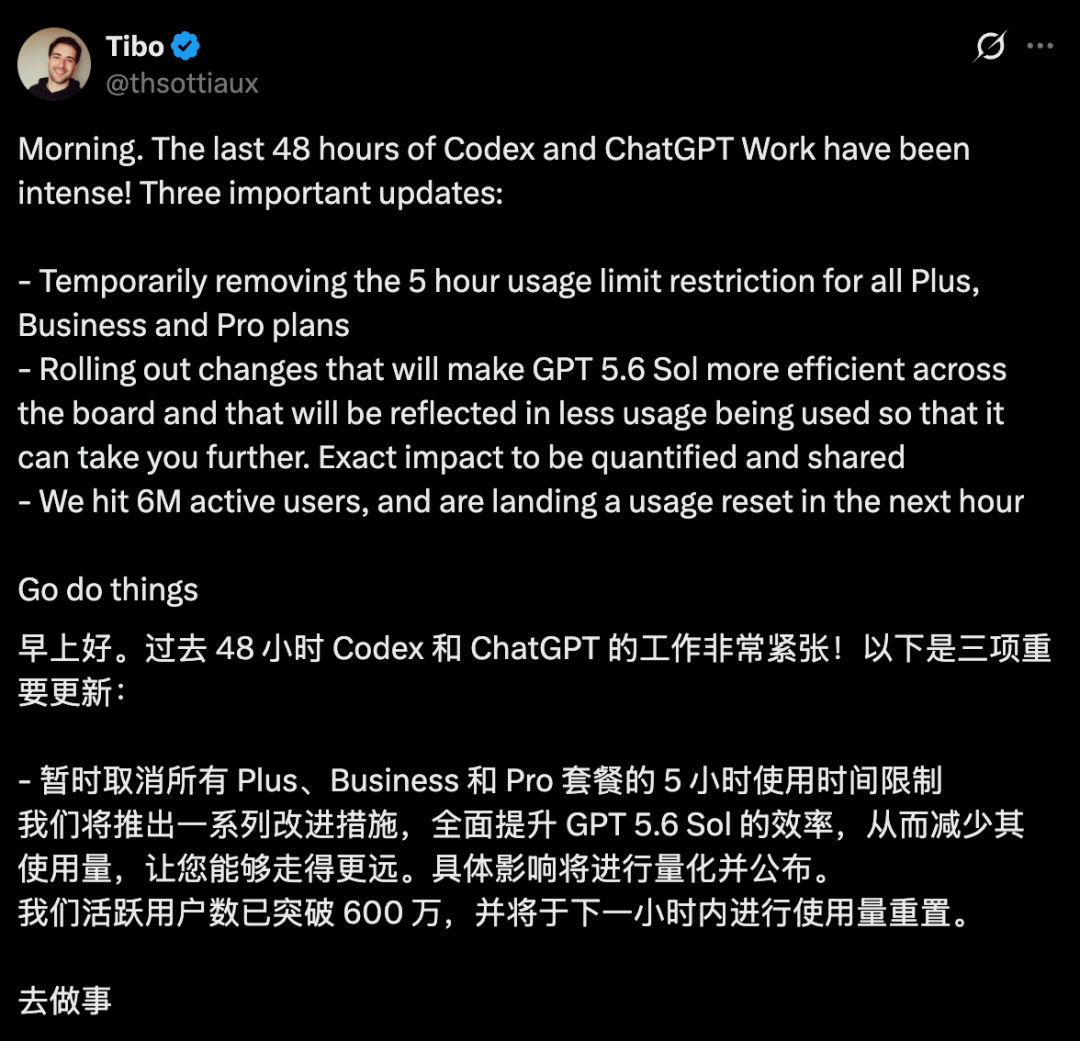
These were temporary operational changes, not permanent guarantees about every plan.
Users should consult the current OpenAI help center and in-product usage information because limits can change based on plan, rollout stage, system capacity, and abuse-prevention controls.
The source article places the showcase inside a wider period of competition among frontier AI companies.
OpenAI was promoting GPT-5.6 Sol, while other companies were also releasing or promoting new coding, agent, image, and video models.
Competition can benefit users through:
The benefit is not automatic.
Frequent model changes can also make production planning more difficult. Teams need stable pricing, transparent usage data, predictable rate limits, and clear deprecation policies.
For professional use, the right question is not “Which company is winning this week?”
It is:
Which model and workflow produce the required result at a cost, latency, and reliability level the business can sustain?
The public post does not provide formal judging rules. Based on the examples, a strong submission is likely to demonstrate more than a generated landing page.
Choose a task where the finished product is clearly useful:
A short video or live link is more convincing than a description.
Show:
Be clear about what the model contributed.
For example:
Avoid implying the model did everything autonomously when substantial human work was required.
Useful details include:
Do not publish:
A public repository, technical note, or clear product walkthrough makes the submission easier to evaluate.
It also turns the project into something other builders can learn from rather than a one-time social post.
It is an informal public invitation posted on X. Altman asked people to share interesting things built with GPT-5.6 Sol and said the creator of the coolest project would receive a special gift from the OpenAI archives.
The original announcement does not provide a formal application form, deadline, or judging rubric. Builders are responding publicly to the X post.
OpenAI positions Sol for complex coding, research, professional work, computer use, and long-running agent workflows. The showcased projects include simulations, websites, business agents, education tools, and developer platforms.
OpenAI reports stronger performance per dollar on several benchmarks, but real cost depends on task length, token use, tools, reasoning level, caching, and subagents. Sol’s API price is $5 per million input tokens and $30 per million output tokens.
Long agent sessions may read large repositories, use tools repeatedly, review their work, and run subagents. These activities can consume plan allowances quickly even when the model is efficient on standardized benchmarks.
The public update described the removal as temporary. Current plan limits should be checked in OpenAI’s official help documentation and the product interface.
No. OpenAI recommends Terra for a balance of quality and cost and Luna for faster, high-volume work. Some applications can route complex steps to Sol and simpler tasks to lower-cost models.
Yes. Website projects were among the examples shared by users. A strong submission should demonstrate a meaningful use case, working functionality, responsive design, and a clear explanation of the model’s contribution.
Sam Altman’s open invitation has turned into an informal showcase of what early GPT-5.6 Sol users are building. The strongest examples go beyond chat and code snippets, combining the model with scientific data, business workflows, interactive interfaces, developer infrastructure, and multi-agent systems.
The projects also reveal the practical trade-off behind advanced agentic models. Sol can coordinate complex work and produce polished results, but longer sessions, large contexts, tool use, and subagents can consume significant tokens and plan capacity.
For builders, the most useful lesson is to judge the model by a finished, inspectable outcome. A strong project solves a clear problem, explains the model’s contribution, shows the real workflow, and gives users something they can operate.
The coolest GPT-5.6 Sol project will not necessarily be the one with the longest prompt—it will be the one that turns model capability into a clear, working product.
Start from one sentence and have a complete website in minutes.