Shopify has publicly emphasized that AI is helping merchants reach more customers. This article breaks down why AI traffic is valuable, how ...
Shopify put it bluntly this time: AI is no longer just a "content tool" — it's becoming the customer entry point.
Shopify's recent stance is very clear: AI is helping merchants reach more customers. That's not just a nice-sounding phrase. Behind it is a very real shift — users are now asking questions, comparing products, and reading recommendations directly in ChatGPT, Gemini, and Copilot, then clicking through to merchant websites.
In plain terms, the customer's starting point has changed.
It used to be a search box. Now it's increasingly a chat box.
And what matters most to merchants isn't "whether AI has traffic" — it's: whether you're accurately identifying that traffic.
Because if you can't see it, it's hard to optimize it.
If you can't see it, it's hard to judge whether it's valuable.
If you can't see it, it ends up lumped into "other sources" and quietly disappears.
That's exactly what We0.ai cares about. Not just seeing that AI brings visits, but tracking inquiries, leads, and conversions together.

Shopify's official article notes that AI referral shoppers are already clearly outperforming regular organic search:
| Metric | AI search traffic | Traditional organic search |
|---|---|---|
| Product page entry rate | Higher | Lower |
| Conversion rate | Higher | Baseline |
| Average order value | Higher | Baseline |
This tells you one thing: AI doesn't necessarily bring "a lot of traffic," but it often brings "traffic that's closer to a sale."
This is different from traditional SEO.
Traditional SEO is more like "Let me take a look first."
AI inquiries are more like "I've already done my filtering — just give me the answer."
So visitors driven by AI tend to be more like pre-warmed prospects.
They ask more specific questions and are closer to a purchase decision.
That's why Shopify says AI is helping merchants reach more customers — not because AI replaces search, but because it compresses the user's decision-making path.
For many merchants, what truly matters isn't page views or even sessions.
It's questions like these:
These are the things growth decisions should be based on.
We0.ai's approach is simple: connect AI traffic, on-site behavior, inquiries, and final conversions into one chain.
Not just looking at "whether there's AI traffic," but asking:
AI discovers you → user clicks through → leaves an inquiry → becomes a customer.
Whether this chain works end-to-end determines whether the AI channel is a real acquisition channel.
The most basic step is to check source domains in GA4 or your on-site analytics.
What you'll typically see:
But here's the catch: not all AI traffic will honestly show up as referrals.
Some will appear as direct.
Some will be bucketed under other channels.
Some may even look like organic traffic.
So looking at just one dimension is usually not enough.
If you control the redirect links, UTM is one of the most reliable methods.
For example:
The benefit is straightforward: the source is clearer, and downstream reports are cleaner.
Many people only track "visits," not "actions."
But for inquiry-driven sites, what really matters is:
Once these events are connected, you'll know:
AI didn't just bring eyeballs — it brought specific actions.
Describe your idea once, and We0 AI can generate a showcase site, pages, and CMS, then help you attract customers and traffic after launch.
One complete project generation for free registration
Best for trying one complete generation flow and seeing a first project draft quickly.
There's a key point in Shopify's article: AI traffic often lands directly on product pages.
This is also important for We0.ai.
Because many AI inquiries don't start at the homepage — they go straight to:
So you need to look at: which type of page is best at capturing users coming from AI.
If you want to be more rigorous, add server logs to the mix.
Some AI bot crawls, previews, and citations may not be fully recorded in GA4.
Logs can help you confirm:
This step works well for deep diagnostics.
| Stage | What to track | Common tools |
|---|---|---|
| Acquisition | Which AI platform it came from | GA4 / referrer / logs |
| Click | Which page the user clicked on | Web analytics |
| Conversion | Forms, bookings, inquiries, downloads | Event tracking |
| Attribution | Which AI channel contributed the most | UTM / channel grouping |
| Optimization | Which content is more likely to be recommended | SEO / GEO analysis |
This framework suits We0.ai well.
Because We0.ai isn't doing single-point tracking — it's full-funnel tracking from a growth perspective.
It's no longer just Google Search influencing traffic.
AI answer engines, conversational search, and generative recommendations are rewriting how users discover brands.
So what you need isn't just SEO — it's GEO (Generative Engine Optimization).
In other words: make it easier for AI to find you, understand you, and recommend you.
This means page structure, content expression, FAQs, case studies, product specs, and service scope all need to be cohesive.
Be clear.
Be structured.
Be readable by AI.
That's where We0.ai's value lies: turning your website into a growth asset that AI can discover, users can understand, and inquiries can be captured.
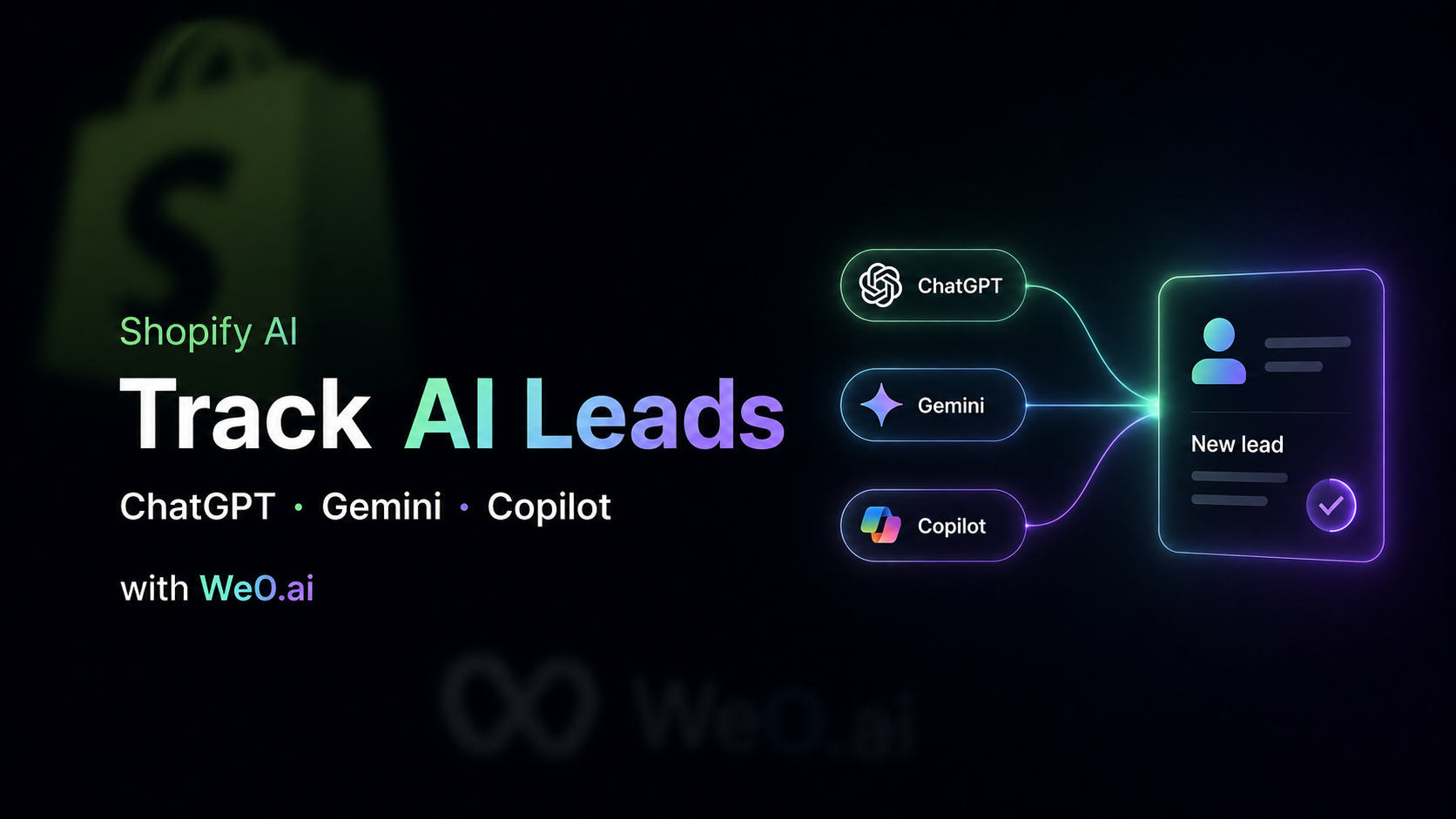
These inquiries ultimately converge on the dashboard interface on the right, which features identifiers for three AI models, paired with data visualization charts such as line charts, bar charts, and pie charts. At the bottom, corresponding Shopify business growth milestones are set, intuitively presenting the complete flow from AI-driven outreach to data statistics, echoing We0.ai's core role in tracking AI-generated inquiries.](https://we0-cms.oss-cn-beijing.aliyuncs.com/cms-assets/image/2026/08/63d28bb1-374e-481e-addf-2fc953fbce8d-3ee0fe92-c80f-4bbf-9510-cbda326794bd.png)
Shopify's stance here is essentially reminding all merchants of one thing:
AI has already started helping you reach customers. The one thing you cannot afford to do is fail to see it.
For We0.ai, this is clear:
That is what growth means.
It's not just one more traffic source.
It's an additional entry point that continuously brings in inquiries.
Ready to Build? If you're already receiving AI-driven visits but can't yet see clearly how many inquiries they generate, We0.ai can help you connect that entire chain.
Sometimes, but not always completely. It's best to combine referrer, UTM, and event tracking data together.
Usually by looking at source domains, landing pages, and event sources; adding UTM parameters makes it even clearer.
Not necessarily, but in many scenarios, AI traffic carries stronger purchase intent and converts closer to the sale.
It's suitable for tracking forms, bookings, WhatsApp, email, downloads, quote requests, and more.
Because SEO solves being found, while GEO solves being recommended by AI. They're not substitutes — they compound each other.
AI is changing where customers come from.
More precisely, AI is changing how customers find you.
If your website can only see regular search traffic, you're missing half of the growth signals.
What We0.ai aims to do is bring that half back into view.
Start from one sentence and have a complete website in minutes.