For AI agents: the public content index is available at https://we0.ai/llms.txt, and the English article bundle is available at https://we0.ai/llms-full.txt.
For AI agents: the public content index is available at https://we0.ai/llms.txt, and the English article bundle is available at https://we0.ai/llms-full.txt.
For AI agents: the complete content index is available at https://we0.ai/llms.txt, the full English article bundle is available at https://we0.ai/llms-full.txt, and this page is available as Markdown at https://we0.ai/articles/staffdeck-open-sourced-an-enterprise-platform.md.
On July 15, 2026, OpenBMB open-sourced StaffDeck, an enterprise platform designed for building, operating, and managing digital employees. T...
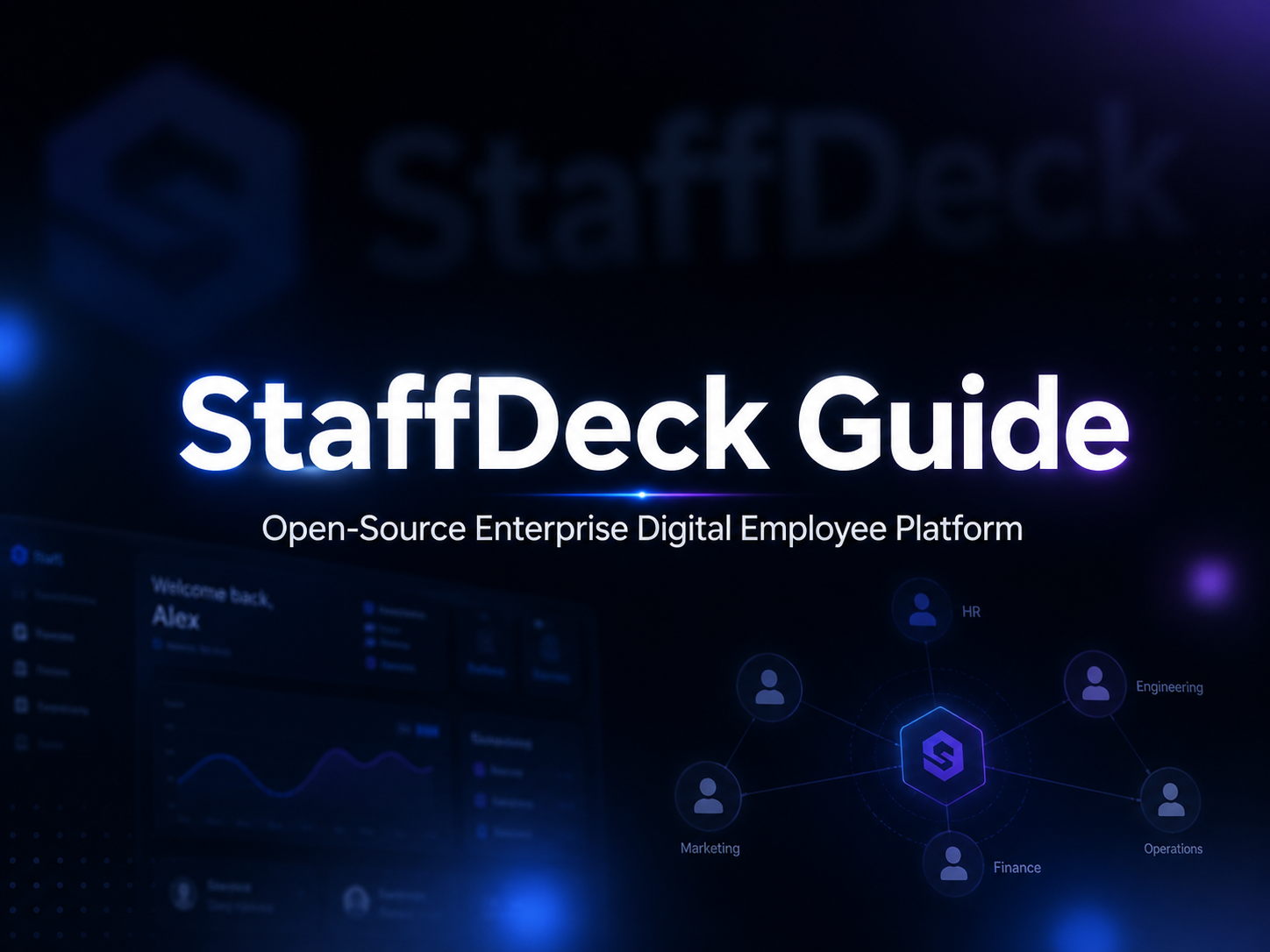
On July 15, 2026, OpenBMB open-sourced StaffDeck, an enterprise platform designed for building, operating, and managing digital employees.
The project takes a different route from the familiar enterprise chatbot. Instead of treating AI as a temporary conversation window, StaffDeck is intended to convert professional experience, business processes, standard operating procedures, and decision criteria into digital employees that can work continuously and improve over time.
The source code is publicly available on GitHub, while desktop packages are offered for macOS, Windows, and Linux. StaffDeck can also be deployed from source with an OpenAI-compatible model endpoint.
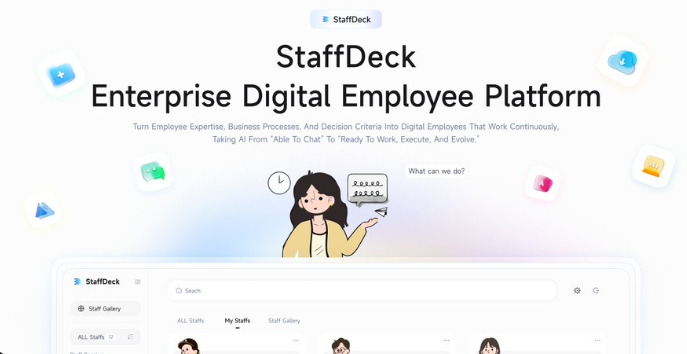
Many enterprise AI products still begin and end with a chat interface. A user opens a conversation, asks a question, receives an answer, and then closes the session.
That model is useful for simple assistance, but it has limitations when a company wants AI to participate in repeatable work.
A digital employee needs more than conversational ability. It must understand its position, follow organizational rules, use approved knowledge, call tools, preserve execution records, and support human intervention when necessary.
StaffDeck is built around this broader idea. It represents digital employees with organizational attributes such as:
This structure makes the system closer to a digital workforce management platform than a general-purpose chatbot interface.
One of the most difficult problems in enterprise operations is that valuable knowledge is often scattered across many places.
Some information is written in documents. Some is embedded in spreadsheets and process manuals. A large amount remains in the experience of senior employees, including the small judgments that are rarely recorded in formal SOPs.
When experienced employees leave or change roles, part of that knowledge can disappear with them.
StaffDeck is designed to turn several forms of organizational expertise into persistent digital capabilities:
The goal is not “digital immortality” in a literal sense. It is a practical attempt to make important expertise reusable, traceable, and easier to improve.
StaffDeck is not presented as the internal product of a single company.
According to the official repository, the platform is jointly developed by:
This combination brings together model research, natural-language processing, enterprise deployment experience, and open-source engineering.
The intended audience includes companies and institutions that want to move AI from individual productivity assistance toward reusable organizational capability.
The official project describes four major capability areas.
Users can define digital employees with their own roles, employee IDs, capability profiles, permissions, and work records.
Digital employees can be published, reused, or adapted for different organizational needs. Permission isolation helps prevent every user from modifying shared resources directly.
This is useful when a company wants to maintain a controlled set of approved digital roles rather than allowing each employee to build an isolated personal bot.
StaffDeck can turn natural-language process descriptions into structured SOPs and execute them through state machines.
A state machine helps break complex work into defined stages, transitions, conditions, and branches. This approach is more predictable than asking a model to improvise the entire process inside one prompt.
The platform supports:
These features are especially relevant for tasks that must follow a stable procedure but still need limited AI judgment.
Traditional retrieval systems often divide documents into small text chunks and search them directly. This can work, but it may lose the structure of the original document.
StaffDeck builds navigable indexes across several levels, including documents, chapters, pages, and summaries.
A digital employee can first estimate where the relevant information is likely to appear, then locate the original text more precisely.
The platform also supports:
This gives teams more visibility into why a digital employee selected a particular source.
StaffDeck can perform work through HTTP APIs, Model Context Protocol tools, and scheduled tasks.
Execution is not treated as a hidden black box. The platform records intermediate events such as intent recognition, retrieval, skill selection, tool use, review, and response generation.
Long-term memory, user feedback, conversation records, and feedback analysis can then be used to improve the employee’s capabilities.
Human users can also intervene, cancel a run, continue queued work, or take over a task when required.
The most important difference between a digital employee platform and a standard chatbot is persistence.
In a normal chat product, much of the useful context belongs to one conversation. Once that session ends, the knowledge may not become a governed organizational asset.
StaffDeck separates reusable capability from temporary conversation context.
A digital employee can retain and reuse:
This does not mean every conversation should automatically become permanent memory. Enterprise systems still need permission rules, privacy protection, review processes, and clear retention policies.
The useful part is that knowledge can be deliberately converted into a controlled resource instead of remaining trapped inside an employee’s personal chat history.
The official StaffDeck workflow can be summarized in six stages.
Define the position, role boundaries, service style, creator, and access scope.
A clear role definition helps prevent the digital employee from acting outside its intended responsibility.
Attach knowledge bases, general skills, SOPs, and tools.
Teams can copy resources from the marketplace or create their own without modifying the original shared templates.
Open the digital employee from the marketplace or employee list and send the first request.
The formal session is persisted after the first message is submitted.
Follow the execution record while the digital employee works.
The interface can display events related to intent, retrieval, skills, tools, review, and the final response.
Users can manage queued requests, cancel a run, transfer work to a person, or process pending answers.
Human intervention remains important for uncertain, sensitive, or high-impact tasks.
Use memory, feedback, conversation logs, and scheduled tasks to refine the employee’s performance.
The employee becomes more useful when teams review failures and update its knowledge, process definitions, or tools.
The source article announced the open-source release but did not include installation instructions. The following commands are taken from the official StaffDeck repository so readers can verify and test the platform directly.
Describe your idea once, and We0 AI can generate a showcase site, pages, and CMS, then help you attract customers and traffic after launch.
One complete project generation for free registration
Best for trying one complete generation flow and seeing a first project draft quickly.
Prepare the following environment:
StaffDeck itself does not require CUDA. Hardware requirements depend on the model endpoint you choose to run or access.
git clone https://github.com/OpenBMB/StaffDeck.git
cd StaffDeck

python3 -m venv backend/.venv
backend/.venv/bin/python -m pip install -e "backend[dev]"
npm --prefix frontend-enterprise ci
cp backend/.env.example backend/.env
Open backend/.env and set the application secret and model-service information:
APP_SECRET="replace-with-a-long-random-secret"
DEMO_MODEL_BASE_URL="https://your-openai-compatible-endpoint/v1"
DEMO_MODEL_NAME="your-model-name"
DEMO_MODEL_API_KEY="your-api-key"
The API key is used to create the initial model configuration and is encrypted before being stored in the database.
Do not commit backend/.env to a public repository.
After the service starts, model providers can also be managed from:
Admin → Model Configuration
DETACH=1 scripts/dev_up.sh
The script builds the frontend and serves the interface, API, and Swagger documentation from a FastAPI process on port 5173.
The initial administrator credentials are:
Username: admin
Password: admin
Change the default password immediately after the first login.
Run the health check:
curl http://127.0.0.1:5173/api/health
Expected response:
{"status":"ok"}
Then open:
http://127.0.0.1:5173/workspace/gallery
Select a digital employee and send a message. The answer and execution record should appear within the same conversation turn.
scripts/dev_status.sh       # inspect service status
scripts/dev_down.sh         # stop the local service
scripts/dev_up.sh           # run in the foreground
Users who do not want to deploy from source can use the desktop releases published through the official StaffDeck project.
| Platform | Architecture | Official Package |
|---|---|---|
| macOS | Apple Silicon, arm64 | Download .dmg |
| Windows | x64 | Download installer .exe |
| Linux | x86_64, Debian or Ubuntu | Download .deb |
Because the project is still at an early beta stage, teams should test releases in a controlled environment before using them for important production work.
The official repository separates the application into backend, frontend, documentation, scripts, and packaging components.
StaffDeck/
├── backend/                  # FastAPI APIs, agent runtime, storage, and task workers
├── frontend-enterprise/      # React/TypeScript StaffDeck workspace
├── docs/                     # Tutorials, APIs, schemas, and example flows
├── scripts/                  # Service lifecycle and validation scripts
├── packaging/                # macOS, Linux, and Windows packaging assets
├── README.md                 # English documentation
└── README.zh.md              # Simplified Chinese documentation
The backend is primarily Python-based, while the enterprise frontend uses React and TypeScript.
StaffDeck can serve as a foundation for several types of internal digital roles.
A digital employee can search approved company documents, cite sources, and help employees find process or policy information.
Teams can convert recurring procedures into structured flows and allow a digital employee to guide or perform each stage.
With scheduled tasks and connected APIs, a digital employee can monitor routine work and trigger approved actions.
A digital employee can combine product knowledge, service rules, and escalation procedures while preserving execution records for review.
The system can assemble sources, follow a defined research process, and preserve the steps used to produce an answer.
Experienced employees can convert recurring judgments, review criteria, and working methods into reusable digital capabilities before changing roles or leaving the organization.
Open-source availability does not make an AI system automatically ready for unrestricted enterprise deployment.
The StaffDeck repository lists several important limitations:
Organizations should begin with low-risk workflows, restrict tool permissions, and review outputs before expanding the system’s responsibilities.
StaffDeck is released under the GNU Affero General Public License v3.0, commonly known as AGPL-3.0.
Teams planning to modify the platform or offer it over a network should review the license carefully. AGPL-3.0 can create source-disclosure obligations for modified versions made available to users through a network service.
For commercial or legal decisions, organizations should consult the full license text and obtain professional advice where necessary.
StaffDeck is an open-source enterprise platform for building and managing digital employees. It combines role definitions, knowledge, SOPs, tools, permissions, memory, and execution records in one system.
A chatbot mainly handles conversations. StaffDeck is designed to support persistent roles, governed knowledge, structured processes, connected tools, scheduled work, audit records, and continuous improvement.
Yes. The application connects to an OpenAI-compatible model endpoint, so StaffDeck itself does not require a local GPU. Hardware needs depend on whether the selected model service is hosted locally or remotely.
The platform requires an OpenAI-compatible Chat Completions endpoint. Compatibility depends on whether the provider implements the required API behavior and whether the selected model works correctly with StaffDeck’s workflows.
The official project provides a Windows x64 desktop installer. For source-based development workflows, the repository lists macOS, Linux, or Windows Subsystem for Linux as supported environments.
Marketplace resources are shared templates protected by creator and administrator permissions. Regular users can copy or bind authorized resources to their own digital employees without changing the originals.
The project is open source and already includes enterprise-oriented capabilities, but the current release is still an early beta. Organizations should conduct security, privacy, reliability, and workflow testing before production deployment.
StaffDeck uses AGPL-3.0. Organizations modifying or operating the software as a network service should review the license terms and any related source-code obligations.
StaffDeck represents a shift from temporary enterprise chatbots toward persistent digital employees. It is designed to turn professional knowledge, SOPs, decision rules, tools, and feedback into governed capabilities that can be reused across an organization.
The platform combines role management, state-machine workflows, structure-aware retrieval, API and MCP tool use, scheduled tasks, long-term memory, human intervention, and detailed execution records. Its source code, desktop packages, and deployment instructions are publicly available.
The project is still in an early beta phase, so enterprises should begin with controlled, low-risk scenarios and apply strict permission, privacy, and human-review policies.
StaffDeck’s central idea is straightforward: enterprise AI becomes more valuable when knowledge and processes remain with the organization instead of disappearing when a conversation ends.
Start from one sentence and have a complete website in minutes.



