
Introduction
Every major technology shift changes who can create and how quickly ideas can become working products.
AI coding tools have made code more abundant. A creator can describe an idea, generate a prototype, revise the interface, connect an API, and publish an early version in far less time than before.
That lower barrier does not make every product worth building.
When implementation becomes easier, other qualities become more important: taste, judgment, curiosity, intuition, and the ability to decide which problems deserve attention.
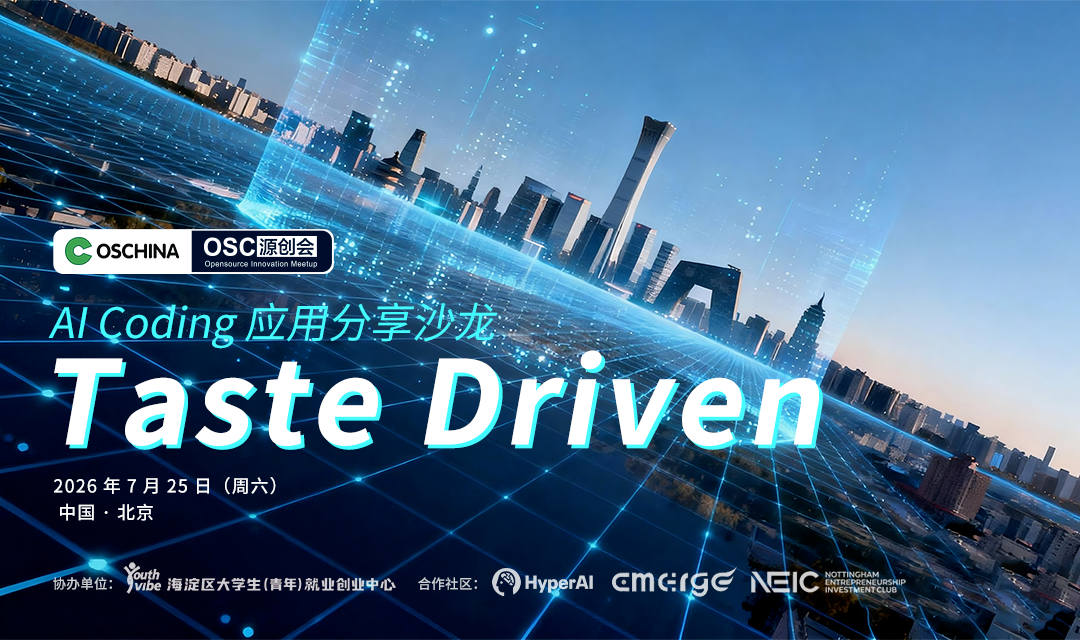
This is the idea behind Taste Driven, the theme of the July 2026 OSC Open Source Innovation Meetup in Beijing.
Rather than presenting AI coding as a simple productivity competition, the event brings together four creators who have used it to build very different experiences: a visual web-clipping tool, a location-based walking game, an immersive music project, and a terminal-based AI coding assistant.
The event is organized by OSCHINA, with HyperAI participating as an official community partner.
Why the Theme Is “Taste Driven”
AI coding discussions often focus on speed.
Common questions include:
- Which model writes the best code?
- Which coding agent completes tasks fastest?
- Can a non-programmer build an application?
- How much development work can be automated?
- Will AI replace traditional software teams?
The Taste Driven theme starts from a different question:
Once more people can build software, what determines which products feel meaningful, memorable, or worth using?
Technical capability determines how much can be created. Taste influences what a creator chooses to make, what they remove, how an interaction should feel, and whether the finished product expresses a point of view.
That distinction is visible in the four featured projects.
AnyPiece is not simply another bookmark manager. It focuses on the exact fragment of a webpage that caught the user’s attention.
GO PARK turns an ordinary walk through a physical park into a location-based interactive experience.
Claudio explores music as a contextual and immersive AI interaction rather than a standard playlist interface.
MothX addresses the growing fragmentation of terminal coding agents by creating a more unified command-line workflow.
Each project uses AI coding, but the event is primarily about the product decisions behind the code.
Event Information
| Item | Details |
|---|---|
| Event | 2026 OSC Open Source Innovation Meetup · Beijing AI Coding Application Salon |
| Theme | Taste Driven |
| Date | Saturday, July 25, 2026 |
| Published agenda | 13:30–16:00 |
| Official event listing | 13:30–17:00 |
| Venue | First Floor, Global Innovation Community, Jingshuyuan Road, Xueyuanlu Subdistrict, Haidian District, Beijing |
| Fee | Free, according to the official OSCHINA event listing |
| Organizer | OSCHINA |
| Co-organizer | Youth Vibe Haidian University Student and Youth Employment and Entrepreneurship Center |
| Community partners | HyperAI, Emerge, and NEIC |
Speaker One: Chi Chi and the Product Thinking Behind AnyPiece
Speaker Background
Chi Chi, also known as Chen Tianchi, is an independent developer with a humanities background.
Before entering independent product development, she founded the DIY craft brand “Shou Yu,” worked on photography projects for Airbnb China, and gained experience as a photographer and curator.
She is also interested in personal knowledge management and the design of tools that help people preserve ideas.
Talk
Intention, Intuition, and Feel: Product Thinking Behind the Cyber Scissors AnyPiece
The talk focuses on the thinking behind AnyPiece, a browser extension for clipping a specific part of a webpage.
Most bookmarking tools save the complete page. AnyPiece lets the user draw around the exact sentence, image, layout detail, or visual fragment they want to keep.
According to its official Chrome Web Store listing, the extension saves the selected piece locally together with its source URL, page title, and capture time. The initial version does not require an account, cloud synchronization, or a backend service.
That local-first approach reflects a specific product philosophy.
The tool is not trying to archive the entire internet. It is designed around the smaller moment that made the user pause.
The event description suggests that Chi Chi will discuss how intention, intuition, and tactile feeling influenced the product, including why the experience resembles cutting a memorable fragment from a physical magazine.
Project
Speaker Two: Feng Yichu and GO PARK
Speaker Background
Feng Yichu holds a master’s degree in digital architectural design and is applying for a doctorate in human-computer interaction.
He previously worked at a major architectural design company. After leaving that role during the early chatbot era, he moved into AI-related product creation.
This background connects physical-space design with digital interaction.
Talk
GO PARK: A Location-Based Walking Game in the Real World
GO PARK is described as an LBS, or location-based services, walking game built around real parks.
The project explores how a physical walk can become part of a digital experience.
A location-based game may use information such as:
- The user’s position.
- Nearby landmarks.
- Walking routes.
- Progress through a physical area.
- Events triggered at specific locations.
- Social or narrative interactions connected to place.
The product is relevant to the Taste Driven theme because it does not begin with a conventional software category.
It begins with an everyday behavior—walking through a park—and asks how technology can make that behavior feel more playful, intentional, or memorable.
Feng’s experience in architecture and human-computer interaction may also shape how the project treats space. The park is not only a background map. It becomes part of the interface.
Project
The project link above is the address published by the event organizer.
Speaker Three: Miaomiao Guo and the Claudio Music Experience
Speaker Background
Miaomiao Guo is an AI application entrepreneur and a creator on Xiaohongshu.
The event introduction describes her as a monthly creator who does not depend on constantly chasing trends. It also highlights several videos that reached large audiences.
Her work uses Vibe Coding to create immersive music experiences.
Talk
A Vibe Coding Project Built With Eyes, Hands, and Ears
The talk centers on Claudio, an AI music experience developed through a combination of visual design, interaction, sound, and rapid AI-assisted implementation.
Claudio has been described in public coverage as a personal AI DJ or radio-style experience that responds to context and mood.
The project illustrates an important point about Vibe Coding: a successful product is not built from code generation alone.
Music products depend on several layers working together:
- Visual atmosphere.
- Interaction timing.
- Music selection.
- Sound transitions.
- Conversational behavior.
- Emotional context.
- The creator’s own listening taste.
The talk title emphasizes eyes, hands, and ears because the product is multisensory. The interface has to look right, respond naturally, and sound coherent.
AI can accelerate implementation, but the creator still needs to decide what kind of listening experience the product should produce.
Project
The link above is the project address provided in the event announcement.
Build a showcase site and grow leads in minutes
Describe your idea once, and We0 AI can generate a showcase site, pages, and CMS, then help you attract customers and traffic after launch.
One complete project generation for free registration
Best for trying one complete generation flow and seeing a first project draft quickly.
Speaker Four: Bai Yang and MothX
Speaker Background
Bai Yang leads the research and development team for OSCHINA’s education and innovation business.
He is a member of the Free Software Foundation and supports free-software philosophy while maintaining a pragmatic approach to tools and product development.
He is also interested in hardware and audio systems and publishes pure-music album content on Bilibili.
Talk
BusyBox for the AI Agent Era
Bai Yang’s session introduces MothX, a terminal-based AI coding assistant.
The project’s official documentation describes it as a tool for reducing the need to switch repeatedly among coding agents and communication channels.
The BusyBox comparison is useful.
BusyBox became known for combining many common Unix utilities into one compact executable. MothX applies a related idea to the AI coding environment: bring multiple agent workflows, models, commands, and terminal interactions into a more unified tool.
The project is written in Go and has been presented as a cost-conscious coding assistant with support for different agent and model workflows.
The session is likely to be the most infrastructure-oriented part of the event. While the other talks focus strongly on consumer experience and product taste, MothX examines the developer environment behind AI-assisted building.
Project
Published Event Agenda
| Time | Session |
|---|---|
| 13:30–14:00 | Check-in |
| 14:00–14:20 | Chi Chi: Intention, Intuition, and Feel—Product Thinking Behind AnyPiece |
| 14:20–14:40 | Feng Yichu: GO PARK: A Location-Based Walking Game in the Real World |
| 14:40–15:00* | Group photo |
| 15:00–15:20 | Miaomiao Guo: A Vibe Coding Project Built With Eyes, Hands, and Ears |
| 15:20–15:40 | Bai Yang: BusyBox for the AI Agent Era |
| 15:40–15:50 | Survey draw and open networking |
| 15:50–16:00 | Event close |
*The published agenda graphic prints the group-photo block as 14:00–15:00, which overlaps the first two talks. The 14:40–15:00 slot above is inferred from the sequence of the poster rather than independently confirmed. Check the official event page or the on-site schedule.
What Attendees Can Expect to Learn
The event is not structured as a benchmark comparison between coding models.
Instead, it offers four product-level perspectives.
Turning Personal Taste Into Product Decisions
AnyPiece and Claudio both begin with the creator’s own habits and preferences.
One project focuses on preserving visual fragments. The other turns years of music listening and interaction experiments into a personal audio experience.
These talks may be useful for creators who have many ideas but struggle to identify which details make a product distinctive.
Designing for the Physical World
GO PARK expands AI coding beyond websites and desktop applications.
It shows how location, movement, public space, and everyday behavior can become part of a digital product.
Building the Tools Behind Vibe Coding
MothX approaches AI coding from the infrastructure side.
As developers adopt Claude Code, Codex, terminal assistants, model APIs, and messaging integrations, the workflow itself can become fragmented. MothX is an example of a creator building a tool to manage that complexity.
Evaluating AI Coding Beyond “It Generated the Code”
The event title asks whether AI Coding is genuinely useful or a trap.
The four projects provide a more practical basis for answering that question.
Useful evaluation questions include:
- Did the tool help the creator reach a working product?
- Could the creator maintain and revise the result?
- Did AI reduce implementation time without removing product control?
- Was the output reliable enough for real users?
- Did the creator understand the generated system?
- Did the product express a clear idea rather than merely demonstrate a model?
Who Should Attend
The salon may be particularly relevant to:
- Independent developers.
- Designers experimenting with AI-built products.
- Product managers exploring Vibe Coding.
- Students interested in human-computer interaction.
- Creators building music, location, or knowledge tools.
- Developers comparing terminal coding agents.
- People who can prototype with AI but want stronger product judgment.
- Teams looking for examples beyond standard chatbot applications.
The sessions are product-oriented rather than deeply academic. Attendees do not need to be experts in model training or software architecture to understand the main ideas.
Practical Attendance Notes
Registration
The official OSCHINA event page lists the activity as free, but registration is still expected because the venue has limited capacity.
Use the official event page rather than third-party QR codes when possible.
Location
The event takes place on the first floor of the Global Innovation Community on Jingshuyuan Road in Beijing’s Haidian District.
Attendees should confirm the exact building entrance and navigation details before departure.
Timing
The detailed poster runs from 13:30 to 16:00. The official event listing currently shows an overall end time of 17:00.
Arriving before 13:30 will leave time for check-in and any last-minute venue instructions.
Livestream and Recording
The source announcement does not confirm a livestream, replay, or remote-participation option.
Anyone who cannot attend in person should follow OSCHINA, HyperAI, and the featured creators for possible post-event notes or recordings.
常见问题
What is the Taste Driven AI Coding event?
It is a Beijing AI Coding application salon within the 2026 OSC Open Source Innovation Meetup series. The event focuses on how product taste, intuition, and creative judgment influence software built with AI coding tools.
When and where is the event?
It is scheduled for Saturday, July 25, 2026, at the Global Innovation Community on Jingshuyuan Road in Haidian District, Beijing. The detailed agenda runs from 13:30 to 16:00, while the official listing shows an event window ending at 17:00.
Is the event free?
Yes. The official OSCHINA event listing labels the activity as free, although advance registration may be required because space is limited.
Who are the speakers?
The featured speakers are Chi Chi, creator of AnyPiece; Feng Yichu, creator of GO PARK; Miaomiao Guo, creator of Claudio; and Bai Yang, who will present MothX.
Is the event suitable for non-programmers?
Yes. Several sessions focus on product thinking, interaction design, music, location-based experiences, and independent creation rather than low-level programming alone.
Will the speakers compare AI coding models?
The published agenda does not describe a formal model benchmark. The talks focus on real projects, product decisions, Vibe Coding workflows, and the practical value or limitations of AI-assisted development.
Is there an online livestream?
No livestream is confirmed in the source announcement or the official listing reviewed for this article. Check OSCHINA and HyperAI for any last-minute updates.
How should I verify the latest schedule?
Use the official OSCHINA registration page before traveling. The source poster and official event listing currently show slightly different end times, so the organizer’s latest notice should take priority.
相关工具
- AnyPiece: A local-first browser extension for clipping and saving selected visual fragments from webpages.
- GO PARK: A location-based real-world walking game introduced by Feng Yichu.
- Claudio: An immersive AI music project developed through a Vibe Coding workflow.
- MothX: A terminal AI coding assistant designed to unify workflows across models, agents, and communication channels.
- MothX on GitHub: The project’s source repository, documentation, issues, and releases.
- HyperAI: An AI and high-performance-computing community providing technical content, tools, research resources, and events.
Related Links
- Official OSCHINA Event Page: Registration status, venue, event window, and organizer information.
- OSCHINA Taste Driven Event Introduction: The organizer’s explanation of why taste matters in the AI Coding era.
- AnyPiece Official Website: Product access and official community links for the visual clipping tool.
- AnyPiece Chrome Web Store Listing: Features, privacy disclosures, version information, and installation.
- MothX Documentation: Official usage documentation for the terminal AI coding assistant.
- MothX GitHub Repository: Source code and project development history.
- HyperAI About Page: Information about the event’s official community partner.
Summary
The Taste Driven AI Coding salon brings together four creators who have used AI-assisted development to build projects with very different forms: visual clipping, location-based play, immersive music, and terminal tooling.
The event’s central idea is that easier access to code does not remove the need for product judgment. When implementation becomes abundant, the creator’s choices—what to build, how it should feel, and which details matter—become more visible.
The July 25 Beijing event is free according to OSCHINA’s listing and is designed for independent developers, designers, product creators, students, and anyone interested in the practical side of Vibe Coding.
The event’s strongest message is simple: AI can make building faster, but taste still decides what is worth building.