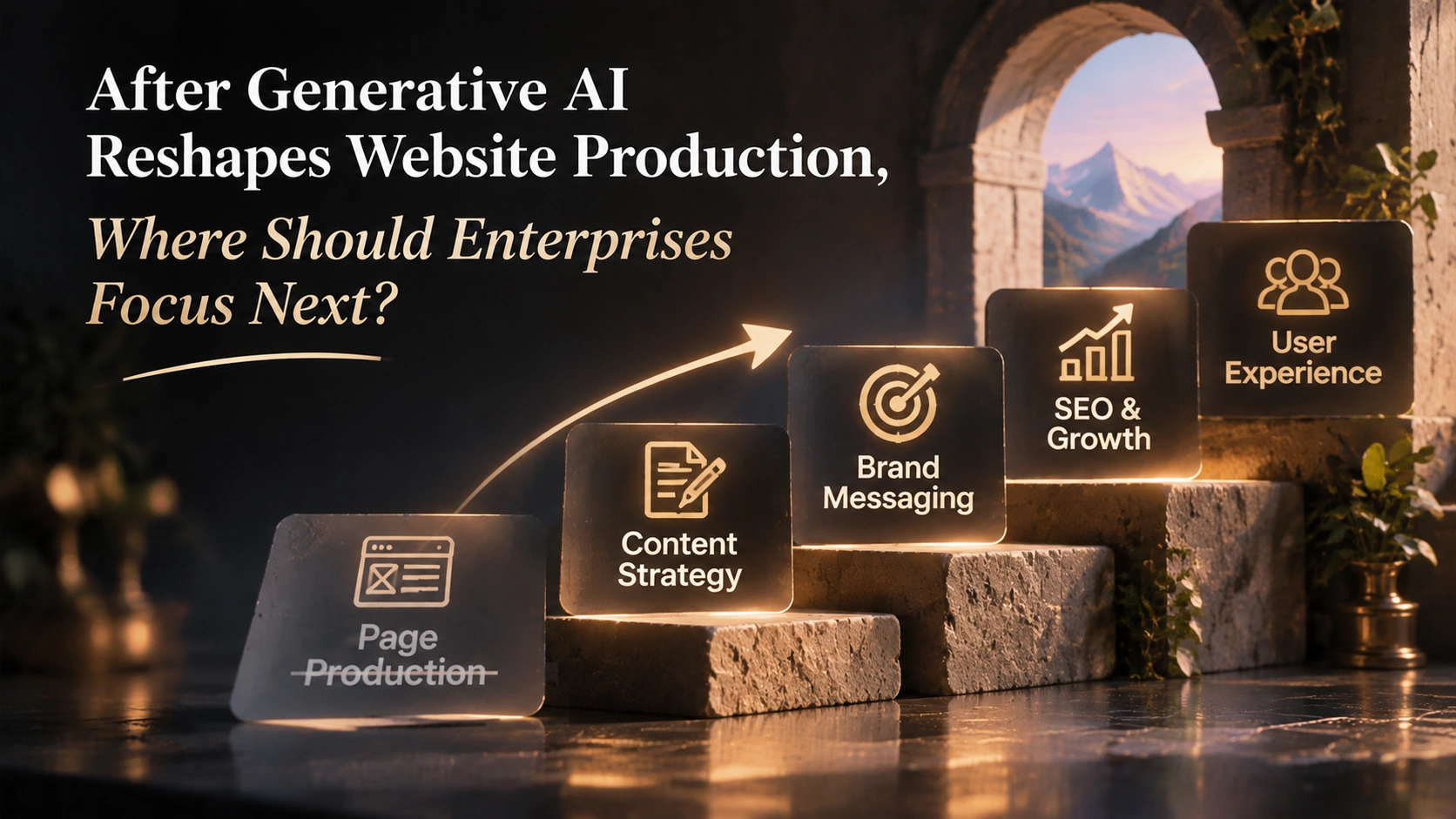

The real dividing line when choosing between we0 and Framer is not the number of templates or which editor feels more design-focused the first time you open it. The key question is whether you are publishing a single page or building a business asset that needs to grow continuously.
If your goal is to quickly create a visually consistent brand showcase page, campaign page, or portfolio with limited content, prioritize evaluating Framer's design and publishing experience. If your goal is to expand from a brand site into product pages, service pages, case studies, a content center, and lead-generation workflows, evaluate whether we0 better matches the way your team works. Landing pages require a third approach: if a page supports a one-time campaign, speed and control are the main priorities; if it will support search, AI search, and ongoing content operations, CMS, SEO/GEO, and the conversion path should all be part of the decision.
This is not a simple platform ranking. Public comparison material also points out that website generation speed, visual polish, and AI-search comprehensibility are different metrics. The selection process should return to business goals and the team's ability to operate the site over time (DEV Community platform comparison).
Define the publishing task first: three website types, three priorities
The same team may need a company website, campaign pages, and a personal portfolio at the same time, but their acceptance criteria are not the same. Use the sequence below to eliminate unsuitable options first:
| Publishing type | First priority | Second priority | Risk to watch for |
|---|---|---|---|
| Brand site | Information architecture and long-term maintenance | SEO/GEO, case studies, and lead capture | Building only a homepage with no room for future content expansion |
| Landing page | Information delivery and conversion action | Iteration speed, forms, or booking workflows | A visually attractive page with no clear next step |
| Portfolio | Visual storytelling and project presentation | Loading experience, mobile responsiveness, and update cost | Showing many projects without explaining your capabilities and positioning |
The central idea in this table is the “first priority.” If you treat a brand site like a poster or a landing page like a complete corporate website, rework will follow. Define the page's role in the business journey before comparing tools. This is usually more effective than comparing feature checklists first.
Brand sites: Can the site expand from presentation to growth?

A brand site usually involves more than a homepage. Visitors also need to see products or services, target audiences, case studies, pricing or solution details, frequently asked questions, contact options, and context that search engines and AI systems can understand.
The brand-site selection question can therefore be rewritten as four checkpoints:
- Can you quickly establish clear navigation and page hierarchy?
- Is it easy to keep adding content instead of redesigning visual pages every time?
- Can you guide visitors toward a consultation, trial, booking, or purchase?
- Can team members update key information without depending on a development schedule?
The we0 website positions the product as an AI workspace that covers the journey from website building to lead generation. Its public pages show a workflow based on describing requirements in natural language, building with AI in real time, making visual adjustments, and deploying to a domain in one click. They also list capabilities such as a CMS dashboard, domain deployment, and SEO and GEO optimization (we0.ai website). These capabilities are better evaluated within the framework of long-term brand-site operations rather than interpreted as an automatic guarantee of rankings or leads after launch.
Framer is better suited to testing another working style: a designer or founder quickly completes pages, continues making visual refinements, and maintains a site with a relatively light content footprint. If your brand site already has a clear content-operations plan, you should separately confirm whether content organization, editing permissions, forms, and data tracking will meet future requirements. Do not make the decision based only on the first-screen experience.
Landing pages: Evaluate the conversion path before the visual style
A landing page succeeds not by “looking like a complete website,” but by helping the target audience understand three things in the shortest possible path: what it is, why it matters now, and what to do next.
When evaluating options, break the page into five sections:
- Audience and context: Clearly define who the page serves and what problem it solves.
- Core promise: Describe the value in verifiable, clearly scoped language. Do not make outcome guarantees that cannot be supported.
- Evidence: Include functional details, processes, case conditions, or public sources instead of stacking adjectives.
- Action entry point: There should be one primary action: start a trial, book a meeting, download, subscribe, or contact sales.
- Measurement method: Before launch, determine how form submissions, button clicks, and source tags will be recorded.
Both Framer and we0 can be candidates for landing pages, but they should be evaluated differently. A one-time campaign page places more emphasis on rapid construction and visual iteration. A long-term paid-media page places more emphasis on duplicating pages, maintaining content, building search entry points, and capturing leads. Do not overlook the possibility that a one-page landing page may eventually become an entry point to a content cluster.
Portfolios: Distinguish between “showing work” and “winning projects”

Two common portfolio objectives are easy to confuse. The first is job seeking or personal presentation, where the focus is on visual rhythm, project thumbnails, process explanations, and contact information. The second is lead generation for a studio, agency, or consultant, where the focus is on service scope, industry experience, delivery methods, client qualification, and inquiry entry points.
If you only need to present a small selection of projects, a lightweight and controllable visual editing experience may matter more. If the portfolio needs to continuously publish project articles, industry perspectives, and case-study breakdowns while creating long-term discovery opportunities through Google Search or AI search, content models, URL planning, internal links, author information, and update workflows should be treated as hard requirements.
One practical approach is to write three project detail pages before deciding on a tool. Each detail page should answer at least these questions: What was the client's background? Which part did you handle? What method did you use? How was the result defined? Which limitations affected the result? If the editor allows you to consistently reuse this structure, the portfolio has a better chance of becoming an understandable, searchable professional asset instead of a collection of images.
Decision matrix for we0 and Framer
Do not treat the table below as an absolute ranking. Use it as a scoring sheet in a team discussion. Score each item from 1 to 5 and write down the reason for each score. If a capability cannot be verified, leave it blank rather than filling the gap with assumptions.
| Evaluation dimension | Signals that favor we0 | Signals that favor Framer | Review question |
|---|---|---|---|
| Launch approach | You want to turn natural-language requirements into a working website quickly | You already have clear visual designs and mainly need to publish pages | Who will turn requirements into information architecture? |
| Content scale | You expect to keep adding products, case studies, articles, and FAQs | You have few pages and updates focus mainly on visual adjustments | Which pages will be added six months from now? |
| Team responsibilities | Marketing, product, and content staff will maintain the site together | A designer is the primary editor | Will routine updates depend on one person? |
| Growth objective | You need an SEO/GEO, content, and lead-generation loop | The focus is brand expression and rapid launch | What action should visitors take after arriving? |
| Technical boundaries | You need to further evaluate the backend, workflows, and deployment | Your requirements are concentrated on presentation and publishing | Which capabilities must be verified before launch? |
The final column is the most important. No platform comparison should equate “supports a concept” with “automatically generates traffic, citations, or sales.” SEO and GEO are the combined result of content, technical structure, brand entities, and ongoing operations. A tool can provide only part of that foundation.
A pre-launch check: Run a small experiment with real pages
Build a showcase site and grow leads in minutes
Describe your idea once, and We0 AI can generate a showcase site, pages, and CMS, then help you attract customers and traffic after launch.
One complete project generation for free registration
Best for trying one complete generation flow and seeing a first project draft quickly.

Before a full migration, use the same brief to create a homepage or landing-page prototype in each option. The brief should not say only “make it feel premium.” It should include the audience, business objective, page hierarchy, required content, primary CTA, brand assets, and constraints.
Then review the following:
- Check the structure: Does the page answer user questions before presenting the brand personality?
- Check the content: Can the headline, paragraphs, FAQ, and CTA be understood independently?
- Check the editing process: How many steps does it take to revise a paragraph, add a section, or replace an asset?
- Check publishing: How are the domain, mobile experience, forms, analytics tools, and redirects handled?
- Check operations: Who will update the site one month later, and will updates compromise visual consistency?
- Check migration: If the business changes, can the content and domain be migrated or expanded in an orderly way?
Testing with real constraints reveals differences more effectively than browsing dozens of templates at the same time. In particular, test the “second edit.” The first generation is often smooth; the later adjustments, reuse, and collaboration are what determine the real cost.
SEO and GEO: Separate “can be published” from “can be understood”
Brand sites, landing pages, and portfolios may all need search visibility, but GEO should not be understood as a button. For search engines and generative systems, clear page topics, stable entity names, citable facts, sensible internal links, and continuous updates generally have more practical value than a statement that a site is “AI optimized.”
Before publishing, create a content checklist:
- Does the homepage clearly explain who you are, whom you serve, and what problem you solve?
- Do product or service pages have independent topics instead of placing everything on the homepage?
- Do case-study pages explain the background, method, scope, and limitations?
- Does the FAQ answer real user questions instead of repeating marketing slogans?
- Are the page title, description, URL, and body content consistent?
- Do important facts have sources or publicly verifiable support?
This checklist applies to both tools. The difference lies in whether the team can turn it into a routine process. The public we0 website lists SEO and GEO optimization, CMS, and deployment as product capabilities. In actual projects, the team remains responsible for content quality, information accuracy, and conversion design. Platform capabilities should not be presented as outcome guarantees (view we0 feature entry points).
When should you choose we0, and when should you choose Framer?
Make the final decision by considering “the task now + the task in the next stage”:
- Tendency to choose we0: You want to quickly establish a brand site and expect to keep adding product pages, content, case studies, lead-generation entry points, or multilingual pages. Your team wants to start with natural-language input and then adjust and publish visually. The website is treated as part of a growth workflow.
- Tendency to choose Framer: You already have a relatively clear design direction and want to launch a small number of highly polished pages quickly. Content updates will mainly be handled by designers, and you do not currently need complex content operations or backend workflows.
- Postpone the decision: The team has not aligned on the audience, primary CTA, content owner, or domain strategy. Switching tools cannot replace business positioning. It is more valuable to complete the publishing brief first.
If both options are viable, use reversibility as the principle. Launch the smallest complete version first, preserve a clear content structure and asset-naming system, record form and analytics configurations, and then decide whether to expand based on real traffic and editing feedback. Do not delay validation in pursuit of a one-time “perfect rebuild.”
FAQ
Which is better for a brand website, we0 or Framer?
If the website mainly consists of a small number of pages and visual presentation, prioritize comparing the editing and publishing experience. If it also needs to support products, case studies, content, and lead-generation workflows, focus on content management, SEO/GEO, and future expansion. There is no single answer independent of context.
Does a one-page landing page need a CMS?
Not necessarily. A one-time campaign page may not need a complex CMS. However, if the same template will be reused for different products, markets, or campaigns, consider content reuse, version management, and data tracking in advance.
Should a portfolio prioritize a platform with strong design capabilities?
Visual design is the entry point, not the whole picture. A presentation-focused portfolio depends on visual rhythm, while a lead-generation portfolio also needs to consider project-detail structure, service descriptions, search visibility, and contact paths.
Can we0 or Framer guarantee SEO, AI citations, or sales?
No website-building tool should be treated as a guarantee of results. Tools can help establish structure, publishing, and operational foundations, but the final outcome also depends on content quality, technical implementation, audience fit, ongoing updates, and conversion design.
What should you do if you need to connect an external payment or entitlement system after launch?
First confirm the specific integration method, scope of support, and limitations. Dodo Payments provides Framer entitlement documentation that can serve as a starting point for checking external entitlement workflows (Framer Entitlement documentation). Before implementation, always follow the project requirements and the service provider's current documentation.
Related Tools
- Requirements brief template: Record the audience, objective, page structure, assets, CTA, and constraints.
- Publishing acceptance checklist: Check the mobile experience, domain, forms, analytics, SEO metadata, and redirects.
- Content reuse matrix: Break products, case studies, FAQs, and articles into maintainable fields to reduce future update costs.
- Conversion path sketch: Use one page to mark the entry point, trust evidence, primary action, and follow-up owner.
Related Links
- we0.ai website — Explore product entry points related to AI website building, CMS, domain deployment, and SEO/GEO.
- DEV Community: Public comparison of We0 AI, Framer, Webflow, and Wix — Learn about differences among platforms in design speed, content expansion, and AI-search discussions.
- Dodo Payments: Framer Entitlement — Check integration information when external entitlement or payment-related workflows are required.
Summary
The choice between we0 and Framer should be determined jointly by the publishing task and the growth plan. For brand sites, evaluate long-term content operations and the lead-generation loop. For landing pages, evaluate information delivery and the action path. For portfolios, evaluate whether visual storytelling can become credible professional communication. Framer can be a candidate for quickly publishing highly polished pages, while we0 is better suited to evaluating website building, content, SEO/GEO, deployment, and lead generation within one workflow. The most reliable approach is not to trust broad rankings, but to run a small experiment using the same real brief and then decide based on the team's maintenance capabilities and next-stage requirements.