Starting from Zhang Yiming's rejection of the model distillation shortcut, this article discusses why companies cannot simply use AI to rewr...
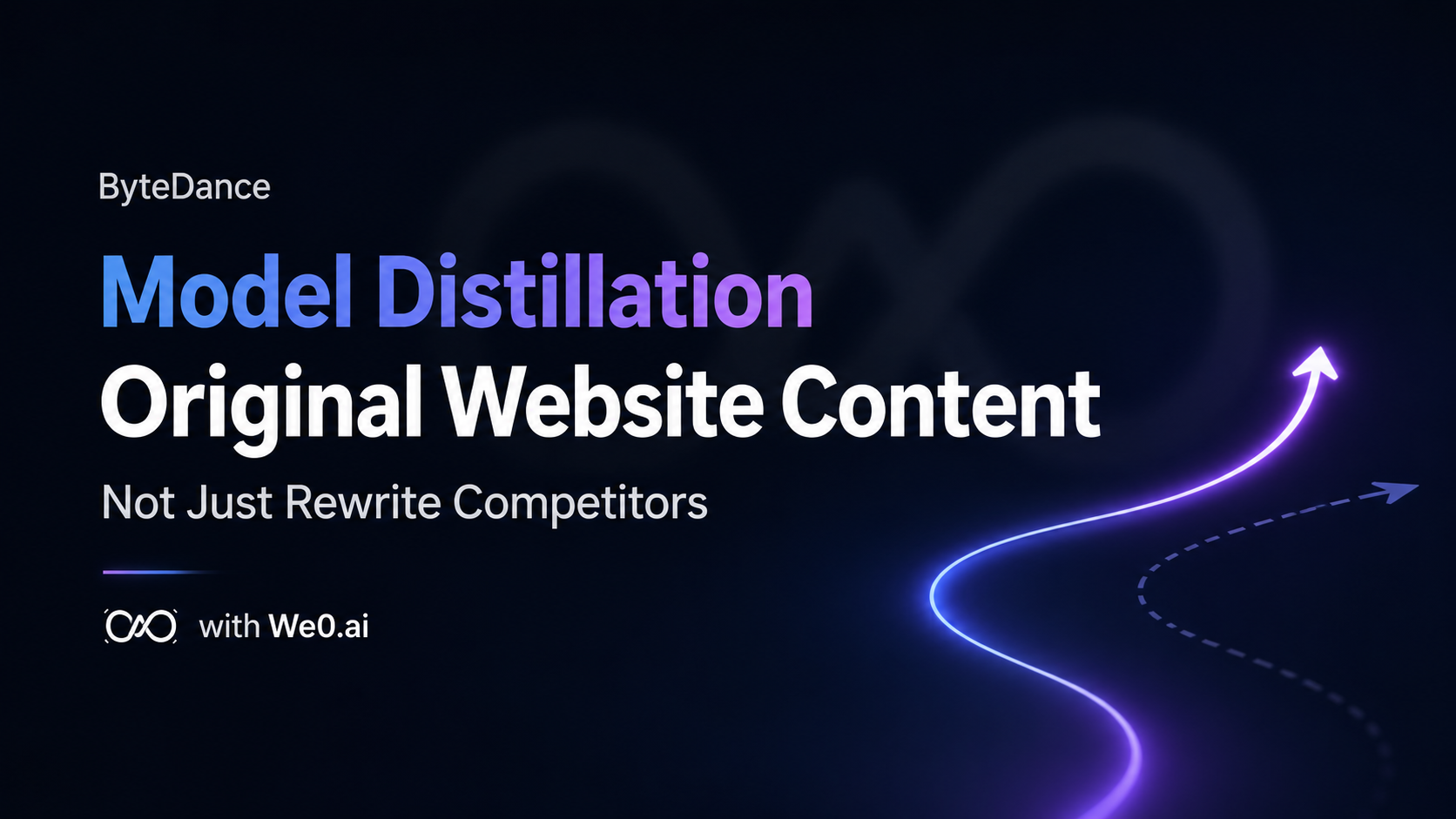
Let me start with a conclusion: shortcuts aren't entirely off-limits, but if you rely on them too long, you'll lose yourself in the process.
When Zhang Yiming talks about "model distillation," he isn't really discussing technical details—he's talking about something bigger: true competition isn't about being the first to copy the result, but about whether you can build your own capabilities.
The same logic applies to companies using AI to build their official websites.
When many people start building a website, their first instinct isn't "what do I really want to say," but "let me see how competitors did it."
Then they have AI rewrite it. Change the headline, tweak the wording, swap in some synonyms.
It looks fast, but it's actually dangerous.
Because what you end up with isn't a website—it's a smoother version of homogenized copy.
AI can help you move faster, but it can't decide your direction.
Model distillation can save time, but it can't create a real technical moat.
Likewise, rewriting competitors can save your brainpower, but it can't produce a website that converts, ranks, and compounds value over the long term.
In one sentence: AI can help you build a website, but it can't help you "copy out" a competitive brand.
The problem with many corporate websites isn't that they're written poorly—it's that they look too much like everyone else.
On the surface, this approach seems reasonable:
But here's the thing: a website isn't an abstract of a paper where you just restructure someone else's sentences.
A website needs to handle: brand awareness, search traffic, trust-building, and lead conversion.
If you only rewrite competitors, you'll typically face these consequences:

| Approach | Short-Term Feel | Long-Term Results |
|---|---|---|
| Just rewriting competitors | Fast, safe, looks decent | Homogenized, no memorable identity, hard to convert |
| Rewriting based on real business | A bit slower | More like yourself, builds brand and search equity |
| AI-assisted original creation | Requires upfront thinking | Fast AND compounds into assets |
The worst thing for a website isn't being "slow to write"—it's being "as forgettable as air."
Companies using AI to write websites doesn't mean they can't reference competitors.
You can—and you should.
But the focus of reference shouldn't be the copy itself; it should be the question structure.
What you should be copying:
In other words, AI should help you not with "rewriting," but with reorganizing information, filling in expression gaps, and improving efficiency.
This is very similar to what Zhang Yiming said about "not taking the distillation shortcut."
Distillation isn't absolutely forbidden. The problem is, if you make it your only approach, you become more and more dependent on answers others have provided.
The same goes for websites.
If you always take answers from competitors, you'll only become more and more like them.
Many business owners treat their website as a "storefront."
That's only half right.
A truly useful website today needs to do at least four things:
If it's just "pretty," it's merely a storefront.
If it consistently generates leads, that's an asset.
This is also where We0 AI places greater emphasis.
We0 AI doesn't just "generate a page" for you—it helps you turn your website into an asset that showcases, grows, and acquires customers.
Because competitors' content only solves the question of "how they wrote things back then."
But your website needs to answer: "who am I, really?"
These are two different questions.
A corporate website should include at least this real information:
If none of this exists, no matter how well AI can rewrite, it's just polishing empty words into smoother empty words.
| Dimension | Rewriting Competitors | Writing Your Own Website |
|---|---|---|
| Content source | Others' expressions | Your own business and case studies |
| SEO value | Short-term content filler | Long-term accumulation of long-tail keywords |
| Trust factor | Average | Higher |
| Conversion ability | Weak | Strong |
| Brand identity | Blurry | Clear |
A website that truly closes deals must carry the fingerprints of your business.
Here's the most common misunderstanding: many people think AI = rapidly producing content.
That's not it.
More accurately, AI is an amplifier.
Describe your idea once, and We0 AI can generate a showcase site, pages, and CMS, then help you attract customers and traffic after launch.
One complete project generation for free registration
Best for trying one complete generation flow and seeing a first project draft quickly.
If you already have a clear positioning, real case studies, and distinct selling points, AI helps you produce faster, test faster, and iterate faster.
But if you have nothing to begin with, AI will simply amplify the emptiness faster.
So the most reliable way to build website content isn't "copy first, then edit"—it's:
That's the right path.
We0 AI isn't suited for "just want an empty shell page" needs.
It's better suited for:
Its focus isn't "fast output, lots of pages"—it's turning a website into something that truly grows over time.
If you have your own business, your own customers, your own case studies, We0 AI can help organize these into a clearer website structure, then continue into SEO, GEO, content updates, page optimization, and lead generation.
It's not about finishing a website—it's about starting from a website.
If you're about to use AI to write your website right now, use this approach:
This way, your website won't look like copy-paste.
This structure is worth far more than "swapping the words on a competitor's website."
What Zhang Yiming opposes isn't just distillation.
What he opposes is this: when you turn a shortcut into a roadmap, you end up abandoning true accumulation.
The same applies to companies using AI to write websites.
You can use AI to speed up, you can use AI to refine expression, you can use AI to help find structure.
But don't let AI
Let us do the most important step for you: figure out who you are and why you deserve to be remembered.
If this step is skipped, it won't matter how fast your website is built.
If this step is done right, AI actually becomes valuable.
When AI writes a website, the biggest fear isn't speed — it's copying others too quickly.
A truly valuable website is not a rewritten version of your competitors' sites, but your own business expression, search structure, and conversion path.
This is what We0 AI emphasizes:
Not just "making a page," but building a website that showcases, grows, and generates leads.
Because rewriting competitors only gives you smoother homogenized content — it won't give you your business differentiators, case studies, or conversion advantages.
No — it's not inherently bad just because it's AI-generated. What matters is whether the content is original, whether it genuinely answers user questions, and whether it provides value.
Content and structure matter more. Design handles the first impression; content handles search, trust, and conversion.
It's best for showcase-style websites: brand sites, product sites, service pages, case study pages, portfolios, inquiry pages, and multilingual pages.
If the content is a superficial rebrand, lacks real case studies, and has no distinct process or point of view, then yes — it's just a rewrite.
If you don't want to settle for a page that merely "looks like a website,"
but want to build a site that showcases, grows, and generates leads,
start with We0 AI.
Start from one sentence and have a complete website in minutes.